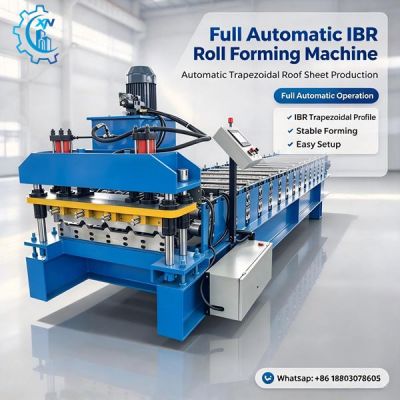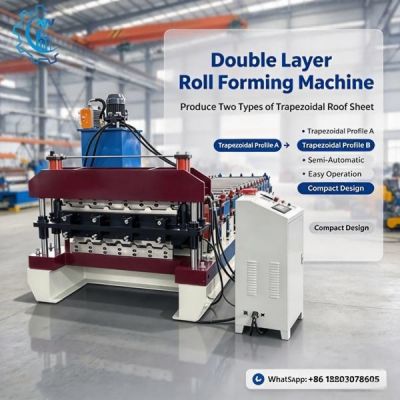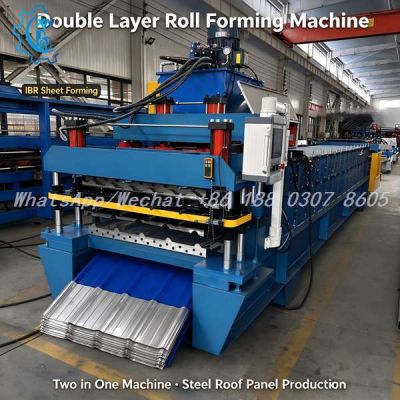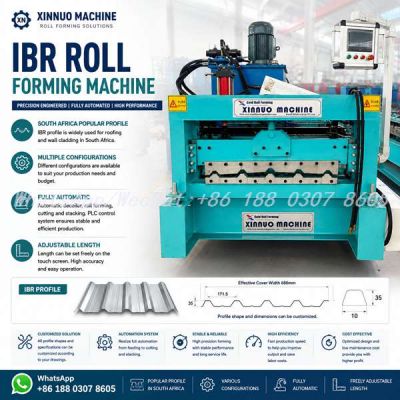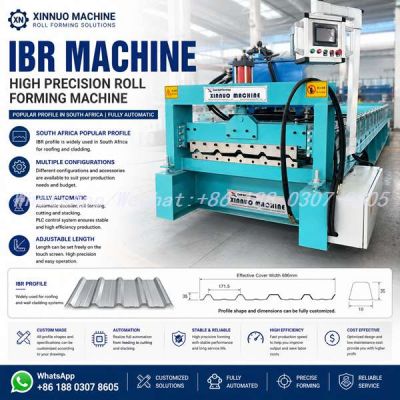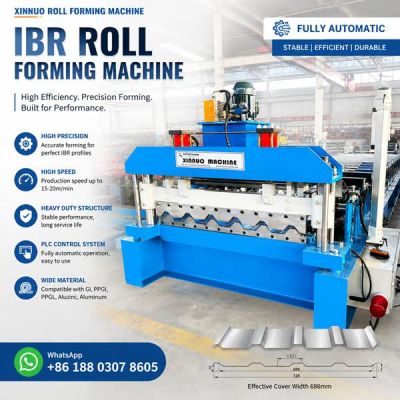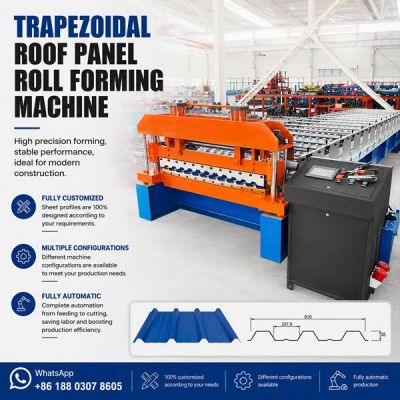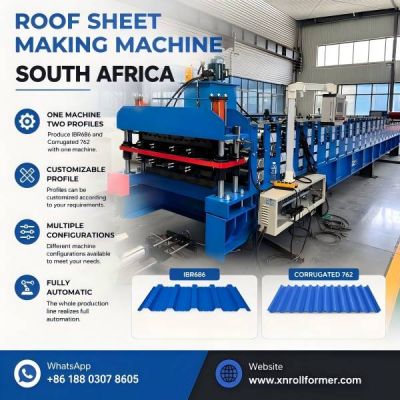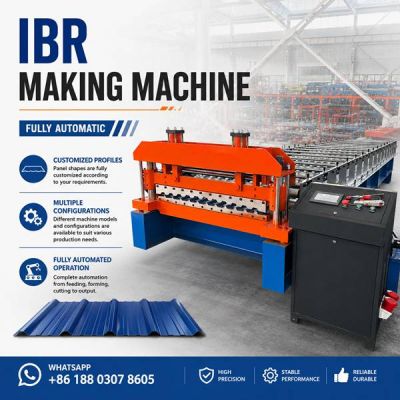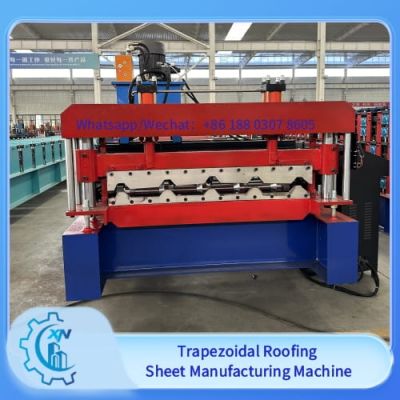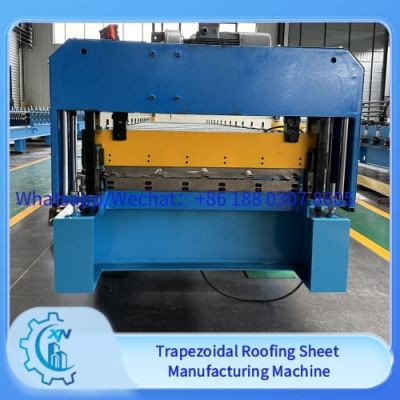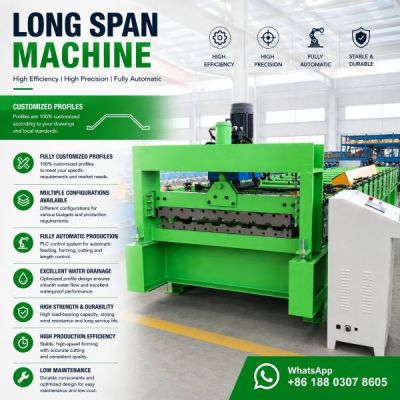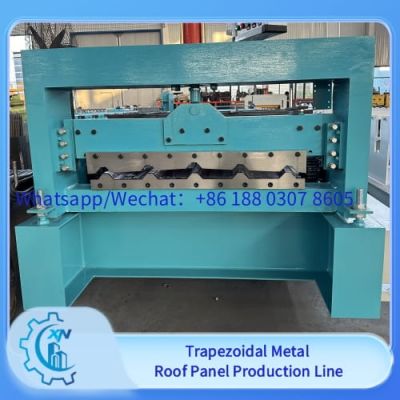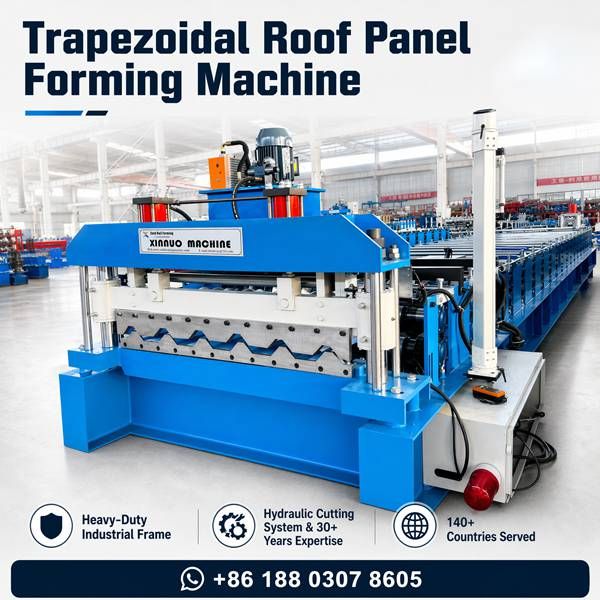
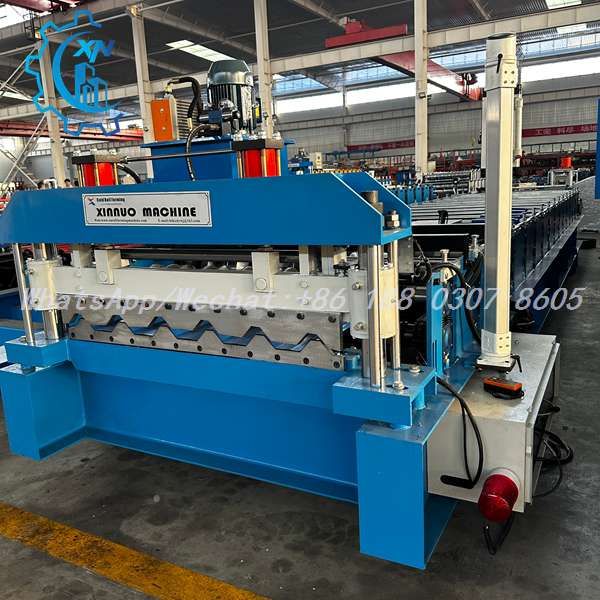
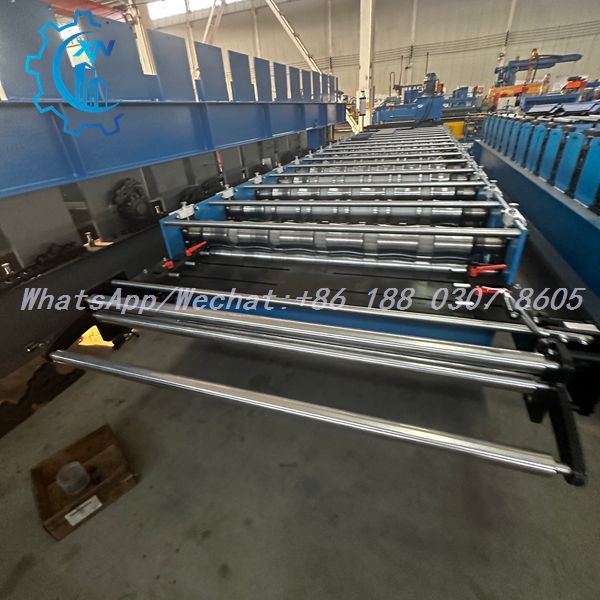
1.XINNUO's heavy-duty profile sheet making machine delivers precision trapezoidal roofing panels at industrial scale. Built on a 350H structural frame with chromium-plated 45# steel rollers and closed-loop hydraulic shear.
2.Mob/WhatsApp/Wechat:+86 188 03078605
3.Email:sara@xinnuomachine.com
1.Precision-Ground Chromium Roller System
Every forming roller on this profile sheet making machine is machined from 45# medium-carbon structural steel on CNC lathes to a surface tolerance of ±0.02mm, then undergoes hard chrome electroplating to a minimum thickness of 0.05mm. Post-plating polishing delivers a mirror-grade finish that eliminates sheet-surface scratching during continuous high-speed forming — a critical differentiator when producing trapezoidal roof panels destined for visible architectural applications. Where commodity-grade machines use unplated or soft-chrome rollers that degrade within 18–24 months, XINNUO's chromium rollers maintain dimensional accuracy across 5+ years of three-shift operation.
2.Closed-Loop Hydraulic Post-Cut Shear
Unlike entry-level machines that rely on mechanical fly-shears prone to burr formation and blade drift, this trapezoidal roof panel forming machine integrates a post-forming hydraulic guillotine shear with proportional pressure control. The blade is forged from Cr12MoV cold-work die steel, vacuum heat-treated to HRC60–62, and mounted on four chrome-plated guide pillars that constrain deflection to under 0.05mm at full stroke. A closed-loop encoder tracks cut position in real time, delivering cut-length accuracy of ±1.0mm at line speeds up to 20 m/min — no burrs, no sheet distortion, no material waste.
3.Scalable Single-Frame Multi-Profile Architecture
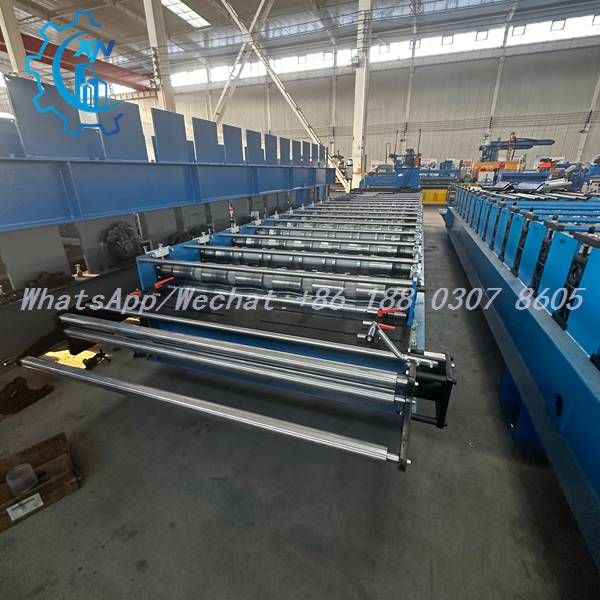
The machine bed is engineered with a modular cassette-style roller station layout, enabling a single profile sheet making machine to produce 3–12 peak trapezoidal panels across effective widths from 600mm to 1,200mm by swapping roller sets — eliminating the capital cost and floor-space burden of maintaining separate dedicated lines. The 350H structural steel frame with box-welded crossmembers absorbs forming forces uniformly across 14–16 stations, ensuring consistent peak height and rib geometry regardless of the profile being run. This architecture future-proofs production: add a new profile tomorrow without buying a new machine.
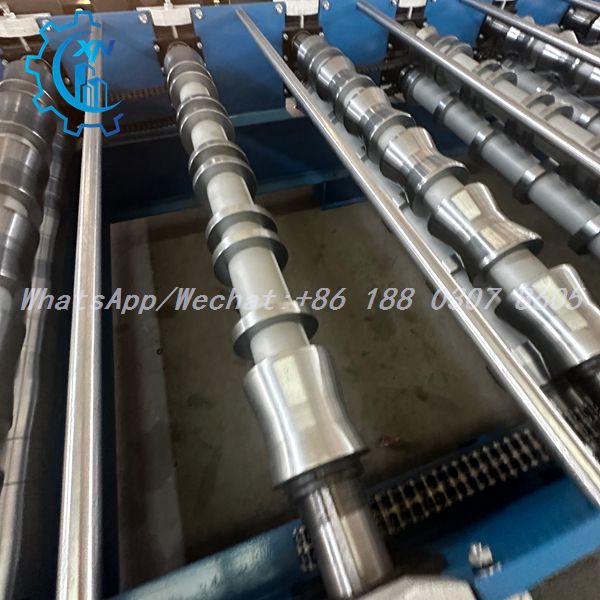
Every forming roller in this profile sheet making machine is precision-machined from 45# medium-carbon steel on CNC lathes, then hard-chrome electroplated to a minimum 0.05mm coating thickness. Post-plating optical inspection verifies surface roughness below Ra 0.4μm — a mirror-grade finish that eliminates sheet-surface scratching even during continuous high-speed forming. The roller bore is honed to H7 tolerance for a slip-fit onto 40Cr alloy steel shafts, ensuring zero radial play after assembly. This roller engineering standard, rarely disclosed by competing Trapezoidal Roof Panel Forming Machine manufacturers, directly governs the panel's surface quality, dimensional consistency, and the machine's maintenance interval between roller changes.
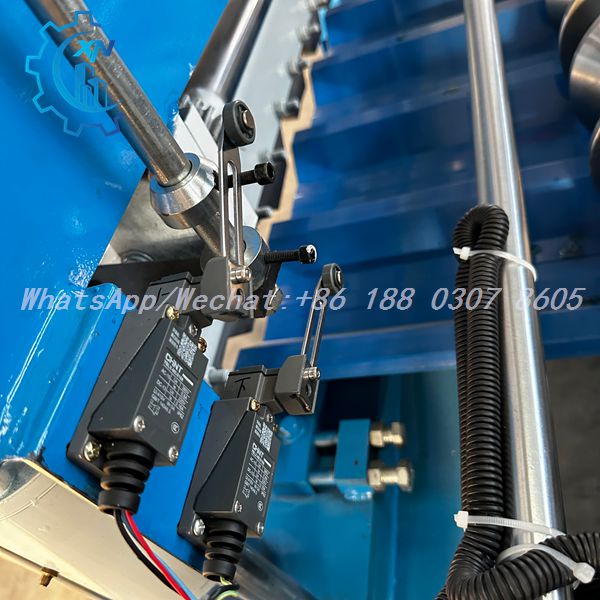
The control architecture of this Trapezoidal Roof Panel Forming Machine is built around internationally certified electrical components — Schneider Electric contactors and circuit breakers, Omron relays and proximity sensors, and Siemens PLC modules with touchscreen HMI interface. Every component carries its original manufacturer serial number and datasheet QR code, providing installers and maintenance technicians with instant access to specification documentation. The DIN-rail layout inside the IP54-rated control cabinet follows IEC 60204-1 machine-safety wiring standards with numbered terminal blocks, segregated power and signal conduits, and a master emergency-stop circuit that kills all motor drives within 50ms of activation. A profile sheet making machine wired to this standard passes electrical-compliance inspection in any regulated market — EU, GCC, Southeast Asia, or Americas — without requiring on-site rewiring.
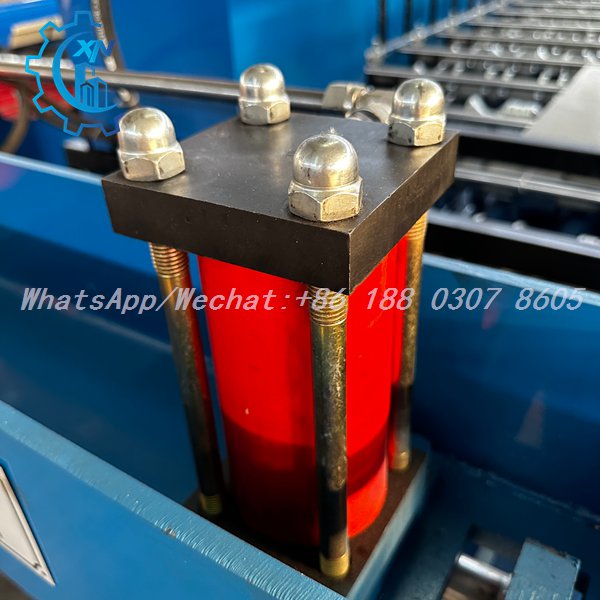
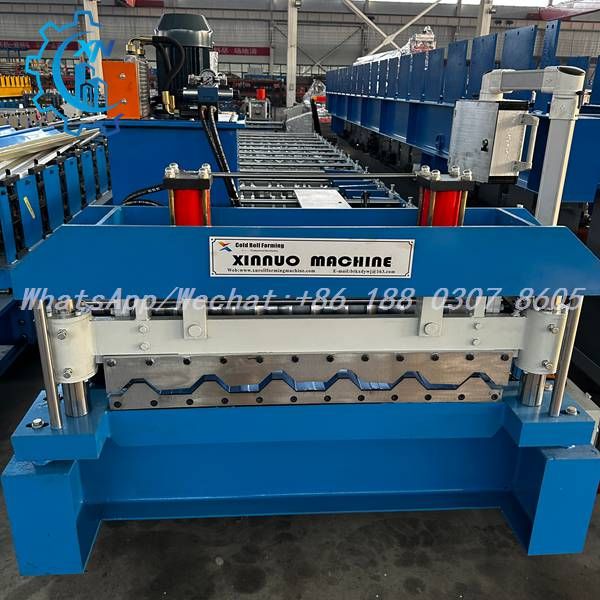
The post-cut hydraulic shear on this profile sheet making machine is driven by two synchronized double-acting cylinders with hard-chrome-plated piston rods and polyurethane step-seals rated for 10 million cycles at 16 MPa working pressure. Each cylinder body is machined from seamless honed tube with a micro-finished bore surface that minimizes seal wear and internal leakage — a detail that separates production-grade hydraulic systems from commodity units that develop drift and inconsistent cut force within the first year of operation. The mounting flange is machined flat to 0.03mm parallelism, ensuring the piston rod extends perfectly coaxial with the shear blade guide pillars. On a Trapezoidal Roof Panel Forming Machine producing 2,000 linear meters of panel per shift, this hydraulic precision translates to burr-free cuts on every single sheet — no secondary deburring, no customer rejects.
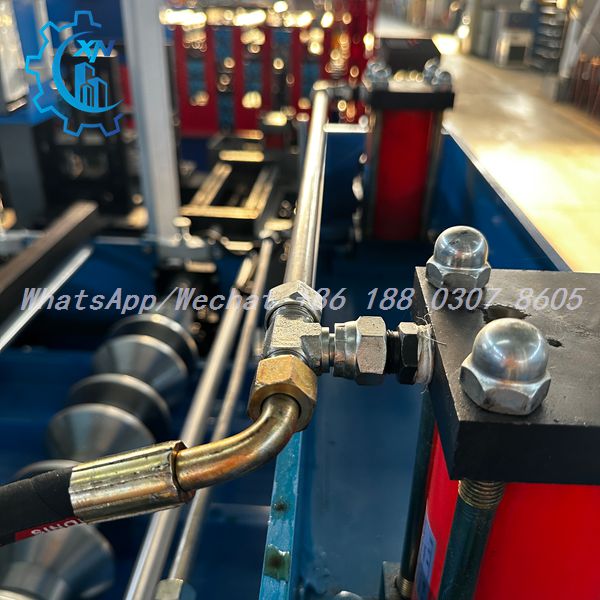
Hydraulic fluid routing on this profile sheet making machine uses 2-wire braided high-pressure hose rated to 40 MPa burst pressure, terminated with 24° cone O-ring face-seal fittings that eliminate the leak-prone tapered-thread joints common on lower-cost equipment. Every hose assembly is pressure-tested at 1.5× working pressure before installation, and each fitting carries a laser-etched torque spec visible on the hex flat. The manifold block is CNC-machined from a solid 45# steel billet with anodized surface treatment to prevent internal corrosion from condensation — a failure mode that silently degrades hydraulic performance on Trapezoidal Roof Panel Forming Machine installations in humid tropical climates. Visible in the image: the proportional directional valve that modulates shear speed and return stroke independently, allowing operators to tune cut-cycle timing without stopping production.
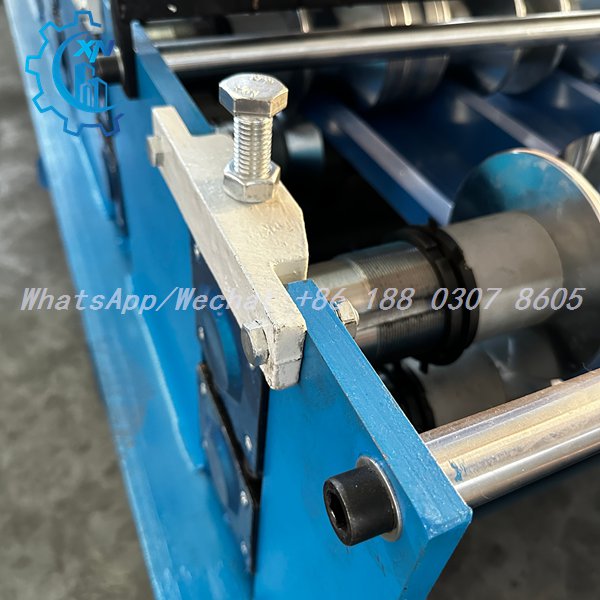
Structural fasteners on this profile sheet making machine are Grade 8.8 and Grade 10.9 high-tensile hex bolts with zinc-flake coating for 720-hour salt-spray resistance — a corrosion-protection standard typically specified for offshore and marine-environment equipment, not general factory machinery. Every bolted joint on the frame crossmembers, bearing housings, and shear-guide pillars uses flat washers and spring lock washers in series to maintain clamp load under the continuous vibration generated by 14–16 forming stations operating simultaneously. The visible torque-stripe markings on each fastener head confirm that the assembly crew followed the documented tightening sequence during final machine build. On a Trapezoidal Roof Panel Forming Machine running three shifts daily, fastener integrity is not a detail — it is the difference between consistent panel geometry and creeping misalignment that forces unscheduled downtime.
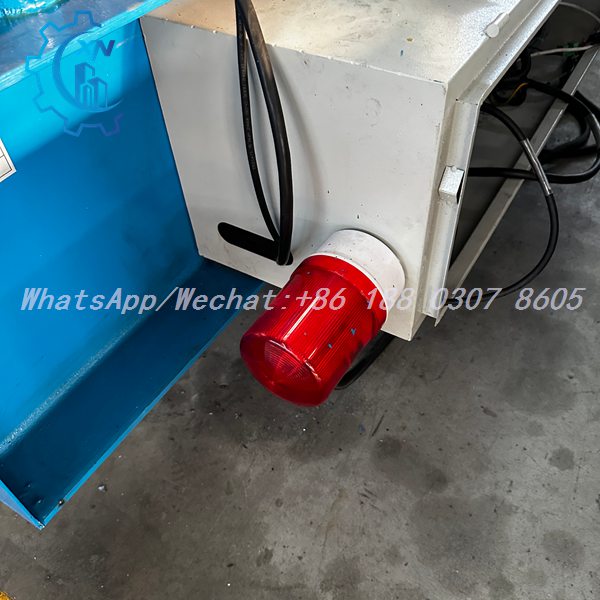
The main control cabinet on this Trapezoidal Roof Panel Forming Machine is fabricated from 1.5mm cold-rolled steel with powder-coated exterior and gasketed door seals to IP54 ingress protection. A high-visibility LED warning beacon — visible from 50 meters across a factory floor — activates in three modes: solid green for normal run, flashing yellow for pause/feed-change, and strobe red for emergency stop or fault condition. The beacon is wired in parallel with the PLC's status-output module and an independent hardware relay, providing a redundant alert path that does not depend on software logic alone. Inside the cabinet, the main disconnect switch, motor overload relays, and 24V DC control-transformer circuit are laid out with finger-safe terminal covers and clear English/Chinese bilingual labeling — a safety-engineering detail that reduces commissioning time and eliminates wiring errors when local electricians first connect a profile sheet making machine to the factory mains supply.
COMPANY INTRODUCE
XINNUO Roll Forming Machine has been designing and manufacturing industrial-grade profile sheet making machine systems since 1995. With over three decades of focused engineering in cold roll forming technology, the company operates from a vertically integrated production facility where every profile sheet making machine is built from raw steel to finished equipment under one roof — a manufacturing model that compresses lead times and ensures component-level traceability unmatched by outsourced assembly operations.
XINNUO's engineering team brings deep metallurgical and mechanical expertise to each profile sheet making machine, starting from the forming roller — the component that ultimately determines panel geometry, surface finish, and long-term dimensional stability. Unlike manufacturers who source generic rollers from third-party workshops, XINNUO machines every roller in-house from 45# structural steel on CNC lathes, followed by precision hard-chrome electroplating and optical inspection before assembly into a profile sheet making machine frame. This vertical integration extends to the hydraulic shear units, decoiler systems, and PLC control cabinets that ship with every profile sheet making machine.
The company's Trapezoidal Roof Panel Forming Machine series represents the most mature product line in its portfolio — 360+ production-proven profile configurations spanning effective panel widths from 600mm to 1,200mm, rib counts from 3 to 12 peaks, and material compatibility across galvanized steel, PPGI, PPGL, aluminum, and zinc-alume coil. Customers deploying a XINNUO profile sheet making machine gain access to this engineering library at no additional cost: select your target profile, and the roller set is designed, machined, and shipped with the machine.
Quality assurance on every profile sheet making machine follows a documented gate-inspection protocol: incoming steel certification → frame weld-NDT → roller dimensional audit → drivetrain alignment check → hydraulic circuit pressure test → PLC I/O validation → full-load trial run with customer-specified material. This systematic approach has earned XINNUO's profile sheet making machine product line repeat orders from roofing manufacturers, construction material suppliers, and prefab building companies across more than 140 countries and regions — from Southeast Asian industrial park suppliers to Middle Eastern construction conglomerates and African infrastructure contractors.
Every profile sheet making machine exported by XINNUO is accompanied by a full documentation package: 3D assembly drawings, roller-arrangement schematics, PLC wiring diagrams, hydraulic circuit blueprints, and a maintenance checklist — all in English. The company's after-sales engineering team provides remote video-guided commissioning for every profile sheet making machine, reducing on-site installation time by up to 60% compared to self-installation. Spare roller sets, shear blades, and chain components for any profile sheet making machine shipped in the past 15 years remain in active inventory and can be dispatched to any international port within 72 hours of order confirmation.
For buyers evaluating a profile sheet making machine investment, XINNUO offers factory acceptance testing (FAT) with live material trials: bring your own coil, run your own profile, verify cut accuracy and surface quality before the machine leaves the floor. This transparent pre-shipment protocol has converted first-time buyers into multi-machine accounts across every continent where trapezoidal roofing profiles are in demand — because when a profile sheet making machine performs exactly as promised, the relationship doesn't end at the bill of lading.
Q1: What materials can this profile sheet making machine process?
The Trapezoidal Roof Panel Forming Machine handles galvanized steel (GI), pre-painted galvanized steel (PPGI), pre-painted galvalume (PPGL), aluminum, and zinc-alume coated coil. Material thickness range is 0.3–0.8mm for steel-based substrates and 0.4–1.0mm for aluminum, with coil width from 750mm to 1,250mm depending on the target profile's feed-width requirement. If your material falls outside these ranges, our engineering team can assess feasibility on a per-profile basis — a standard service that comes with every XINNUO profile sheet making machine inquiry, not a premium upsell.
Q2: What is the production speed?
Standard configuration delivers 15–20 linear meters per minute. The heavy-duty configuration with upgraded motor and chain drive achieves 20–30 m/min. Actual throughput depends on panel profile complexity (higher peak counts require slightly slower forming speeds to maintain geometry) and material gauge. The PLC's recipe-storage function allows you to preset speed parameters per profile, so switching from an 840-type 5-peak panel to a 1000-type panel does not require manual speed recalibration — the Trapezoidal Roof Panel Forming Machine recalls the saved parameter set with one touch.
Q3: Where is XINNUO's manufacturing facility and how large is it?
XINNUO Roll Forming Machine operates from a vertically integrated production facility in Cangzhou, Hebei Province, China — a city historically known as the "Roll Forming Capital of China" due to its concentration of steel-processing expertise, raw-material supply chains, and skilled machine-assembly labor. The facility houses in-house steel fabrication (laser cutting, welding, stress-relief annealing), CNC machining (roller turning, shaft grinding, keyway broaching), hydraulic assembly, electrical-panel wiring, and full-machine trial-run bays — all under one roof. This single-site manufacturing model means your profile sheet making machine never leaves a quality-controlled environment until it is fully assembled, tested, and approved for export packaging.
Q4: What quality certifications does XINNUO hold?
XINNUO maintains ISO 9001:2015 quality management system certification covering design, manufacturing, and after-sales service of cold roll forming machinery. The electrical systems on every profile sheet making machine are built to IEC 60204-1 machine-safety standards, and the hydraulic circuits follow ISO 4413 fluid-power safety guidelines. CE marking is available upon request for machines shipping to EU member states. All material certifications (steel mill test certificates for frame steel, shaft steel, and blade steel) are included in the shipment documentation package.
Q5: Do you provide installation, commissioning, and operator training?
XINNUO provides a comprehensive remote commissioning package as standard with every profile sheet making machine: video-guided installation walkthrough, live-streamed commissioning support with an English-speaking engineer, PLC parameter configuration, and trial-run supervision until the first full coil is successfully formed and cut. For customers who prefer on-site support, XINNUO can dispatch an installation engineer to your facility — travel and accommodation costs are quoted separately. Operator training is included in both scenarios: your team learns machine setup, profile changeover, daily maintenance, and basic troubleshooting directly from the engineers who built the equipment.
XINNUO ROLL FORMING MACHINE CO., LTD is a professional manufacturer specializing in high-quality ibr making machine and advanced ibr machine solutions. With years of industry experience, we provide reliable, efficient, and customized roll forming equipment to meet global roofing production needs, ensuring stable performance, precision forming, and long-term durability for our customers worldwide.
[ read more ]