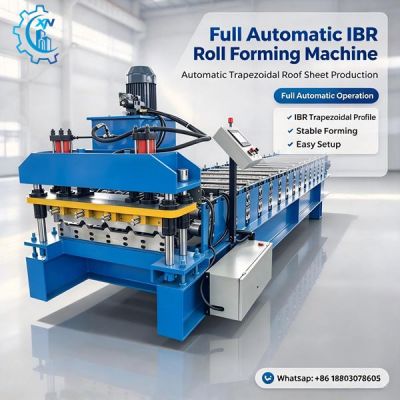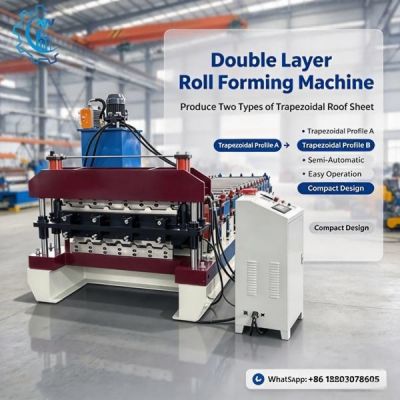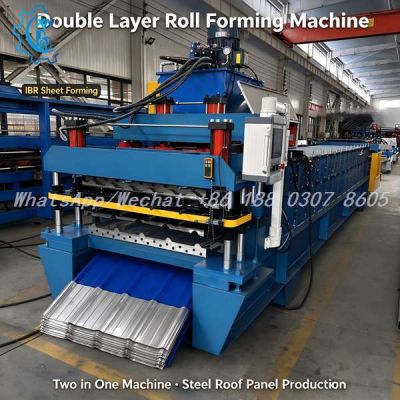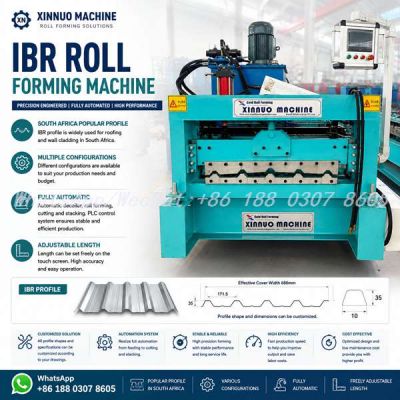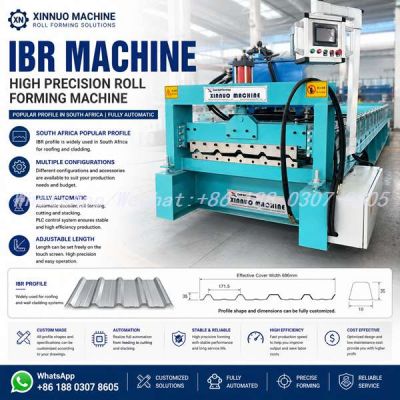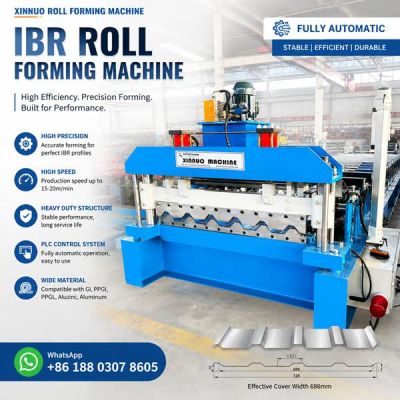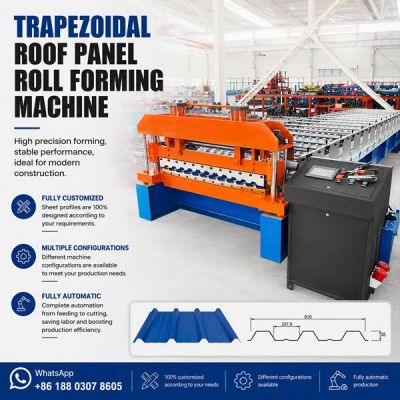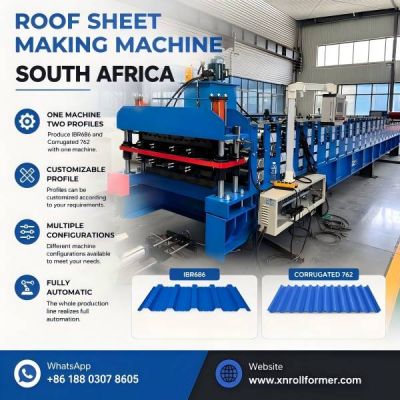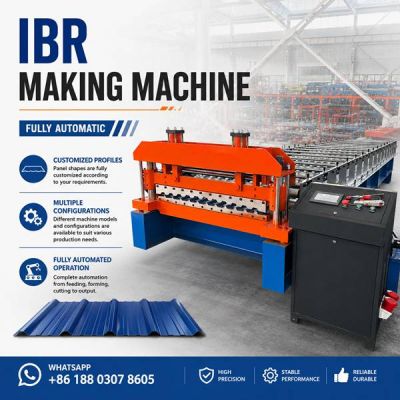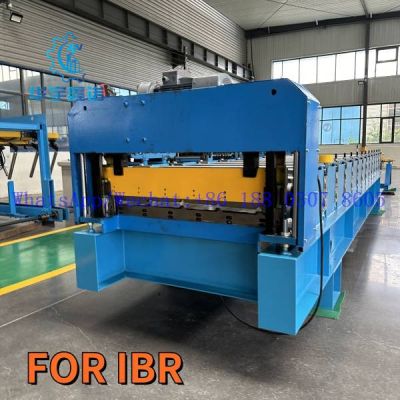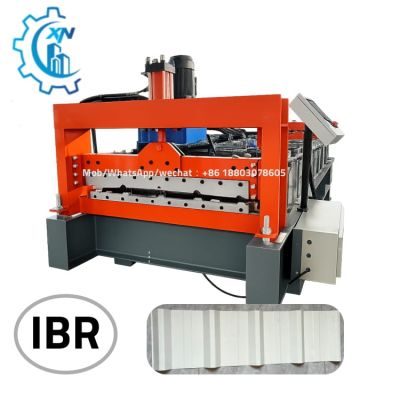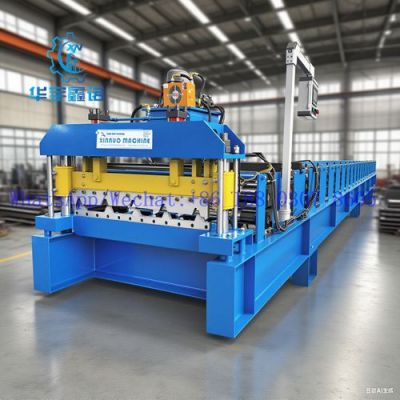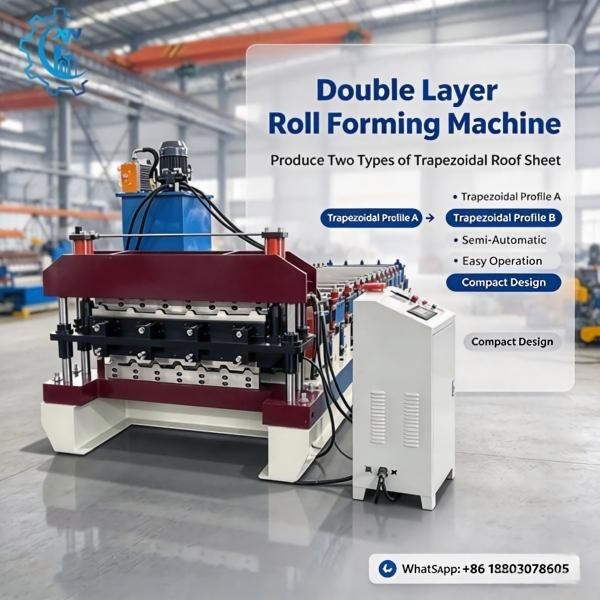
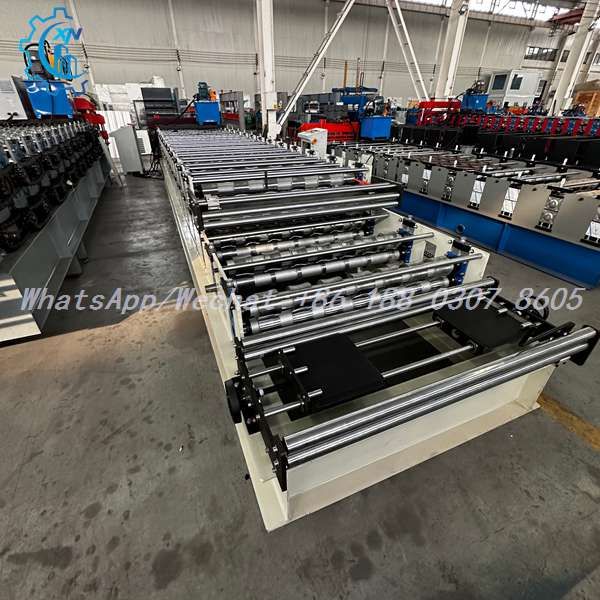
1. Double layer IBR machine - IBR 686 (Inverted Box Rib) roof sheeting forms on one layer and a trapezoidal roof and wall profile on the other, so two sheet profiles come off a single line.
2. Chain driven forming stations: heavy roller chains run along the bed and drive each shaft through its sprocket, with the shaft ends carried in blue bearing housings bolted to the painted frame.
3. Tie-rod hydraulic cut-off cylinder with dies machined to the profile, backed by a hydraulic power pack with oil reservoir, finned motor and fan-cooled heat exchanger.
4. Mob/WhatsApp/Wechat: +86 188 0307 8605
5. Email: sara@xinnuomachine.com
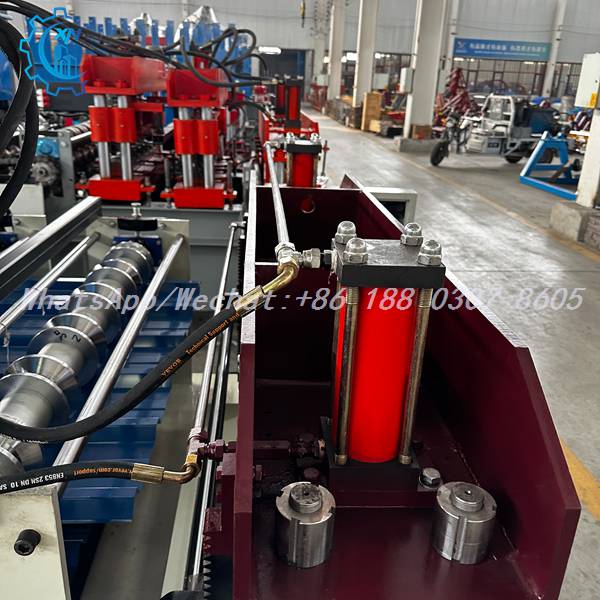
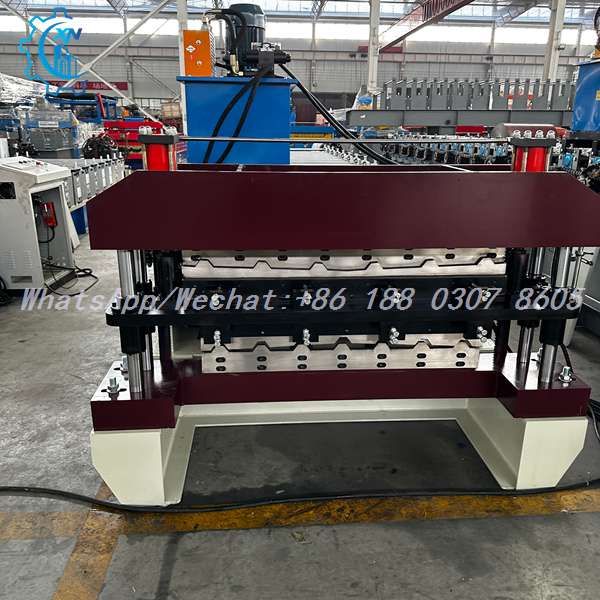
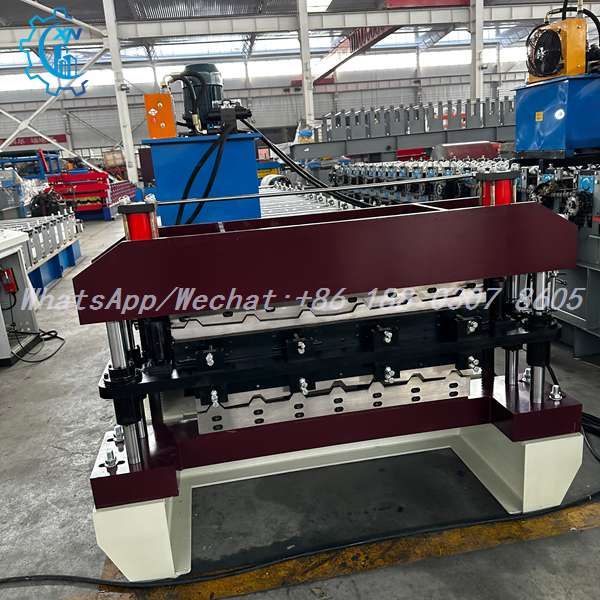
The cut-off of the IBR machine is built around a red hydraulic cylinder standing in its maroon housing: four chrome tie rods with castellated nuts hold the assembly square, a brass elbow and crimped fitting feed the black high-pressure hose, and two polished steel parts stand on the base below. Forming rollers run to the left, above the blue bed. The housing is bolted to the same bed that carries the forming stations.
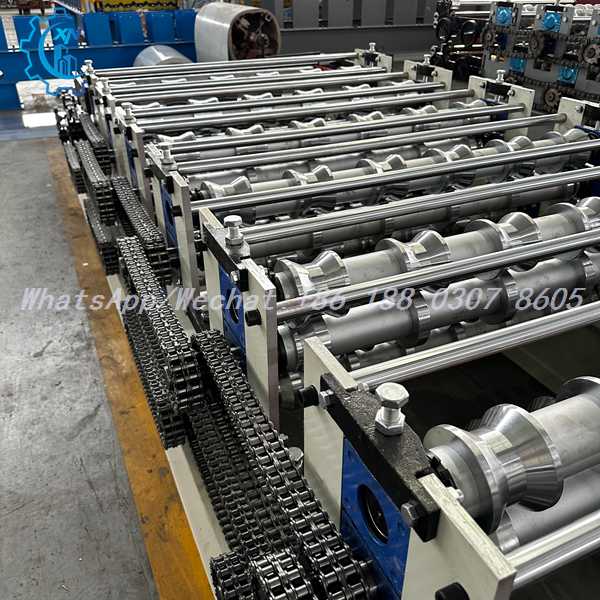
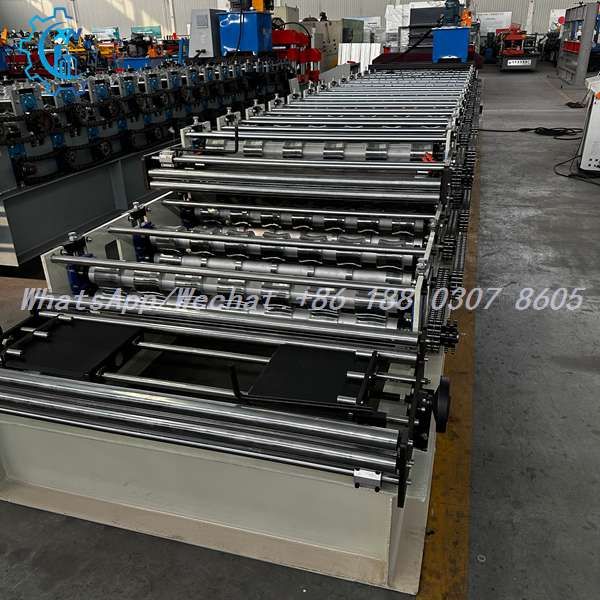
Drive side of the IBR machine: heavy roller chains run in parallel along the bed, each driving a shaft through its sprocket, with the shaft ends carried in blue bearing housings bolted to the frame. Bright polished rollers sit in the pass above, and the painted bed with its adjusting bolts stretches away along the yellow workshop floor line. The chain runs are visible here, with the shafts they drive stepping away along the bed.
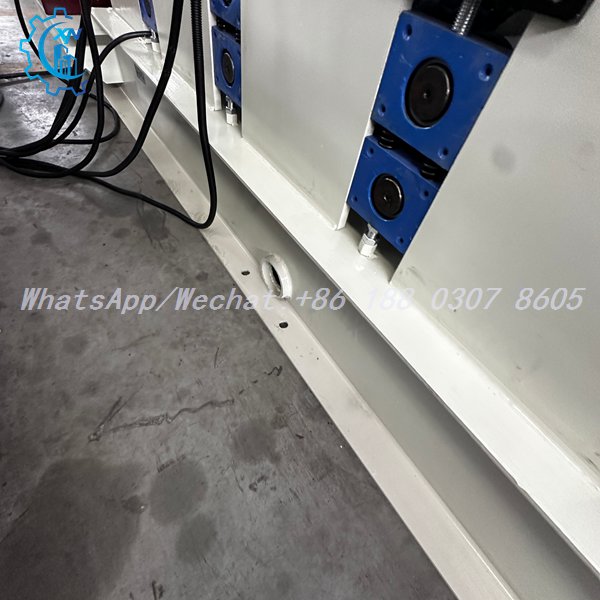
Side of the bed of the IBR machine, seen close up: two blue bearing housings are bolted to the white painted frame, each with a dark round opening where the shaft end is carried, and the base beam below shows slotted fixing holes used to level and anchor the line. Black hoses and cables lie along the side, over the concrete floor. The frame is painted white on this side, with the blue housings standing out against it.
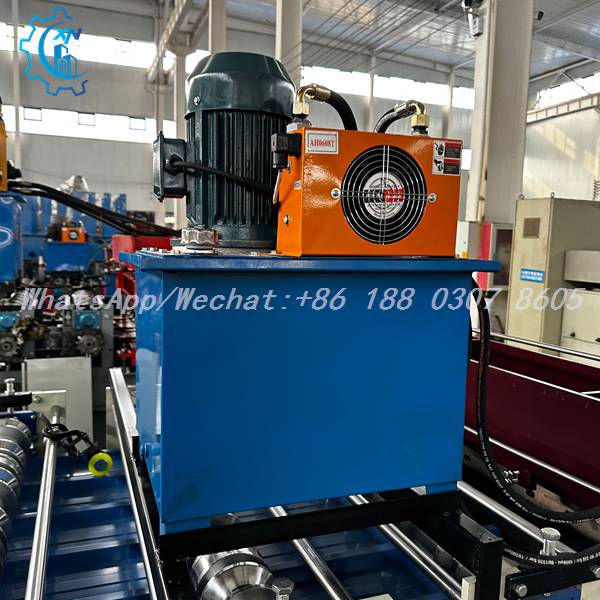
Hydraulic power pack of the IBR machine, set on the line: the blue reservoir stands on raised feet, a dark finned motor is bolted to the tank top on its pad, and the orange cooler box at the side carries an axial fan behind a wire grille with its maker's label and a warning sticker. Brass elbows feed the black hoses running down to the machine. The tank is carried on the line rather than on the floor.
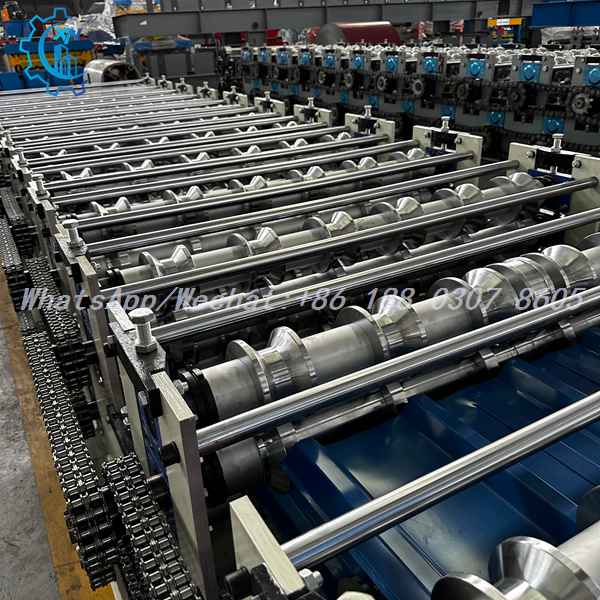
Looking down the pass of the IBR machine, station after station repeats into the distance: each carries a pair of polished rollers on two shafts, their stepped crowns turning the flat coil towards the finished rib, and long polished guide rails run the whole length of the frame. Roller chains sit along the left of the bed, which is painted blue. The stations repeat in the same order from the entry end to the shear.
IBR Machine - Built in the XINNUO Works Since 1995
XINNUO has designed and manufactured IBR machines and cold roll forming lines since 1995. Profile design, frame fabrication, roller turning, hydraulic assembly and electrical wiring all happen in our own works, which is why the forming rollers, chain drive, cut-off cylinder, hydraulic power pack and control panel of your IBR machine are matched to each other before the line is assembled instead of being brought together from separate suppliers.
This double layer IBR machine is built for buyers who sell more than one roof sheet off a single machine bay: IBR 686 (Inverted Box Rib) roof sheeting on one layer, and a trapezoidal roof and wall profile on the other. Both layers are drawn from your own profile drawings, so the cover width and rib pitch suit what your market already buys rather than a catalogue standard, and the second layer can be set up as a trapezoidal profile, a corrugated profile or a tile profile according to the drawings you send.
Every line is run on the customer's profiles before dispatch and the cut is checked on the customer's own coil. The rollers are protected, the modules are packed to suit a 40ft container, and the supply includes the profile plan, layout drawing, test report, setting sheet, operator training and spares support. Machines have been supplied to customers in more than 150 countries, including South Africa, Zimbabwe, Zambia and the wider SADC region.
Q1: What does the second layer of this IBR machine produce?
A: A trapezoidal roof and wall profile. The first layer forms IBR 686 (Inverted Box Rib) roof sheeting; the second layer is built to your own drawing for the trapezoidal sheet you already sell in your market. Because the second layer is drawn from your profile, its cover width and rib pitch follow your specification rather than a fixed catalogue size.
Q2: How are so many forming stations driven on one line?
A: By chain. A roller chain runs along the bed and drives each shaft through its own sprocket, so the forming load is shared along the line rather than carried by a single transfer shaft. The shaft ends are carried in the blue bearing housings bolted to the frame, which makes each one an individual, replaceable unit during maintenance.
Q3: Can the machine run IBR and the trapezoidal profile at the same time?
A: No. The two roller tiers share one bed and one drive, so one layer runs at a time and the material path is switched at the entry guides. If you need IBR and trapezoidal sheet running simultaneously through the working day, two separate lines suit that plan better - we will say so rather than sell you a two-in-one that cannot keep up.
Q4: What has to be reset when you change from IBR to the trapezoidal layer?
A: The material path at the entry guides is moved to the other tier, the guides are checked against the setting sheet, and the roller gap on the stations is verified before the first sheet is run. The first sheet off each layer is measured for cover width and cut length. The changeover sequence is recorded for your machine at commissioning.
Q5: How is the cut-off kept square across the sheet?
A: The cutting cylinder is held by four chrome tie rods inside its housing, and the blade travels between guide columns, which is what keeps the cut square across the full sheet width instead of drifting at the ends. The dies are machined to follow the profile, so the rib is cut rather than crushed, and the sheet leaves the line ready to fix.
Q6: What routine checks does the hydraulic circuit need?
A: Check the oil level in the reservoir and look for seepage at the unions, keep the cooler's fan grille clean so air still passes through it, and inspect the hoses for chafing or a softened spot where they flex. The hose on this machine is a crimped, hose-rated assembly with brass elbows at the cylinder end. The service manual supplied with the line gives the full intervals.
Q7: How is the line set on the floor when it arrives?
A: The line is delivered in modules for a 40ft container. On site, each module is lowered to the layout drawing, the base beam is levelled and anchored using the slotted fixing holes already drilled in it, modules are coupled and aligned, then the electrical and hydraulic connections are made, the tank is filled and the circuit is bled before a first run without coil.
Q8: What documentation, training and spares come with the line?
A: You receive the profile plan, layout drawing, test report from the run on your own profile, a setting sheet for both layers, the operating and maintenance manual, and a spares list with the part references for the wearing items. Operator training is given at commissioning, covering both layers, the cut-off and the daily checks, with remote support afterwards.
XINNUO ROLL FORMING MACHINE CO., LTD is a professional manufacturer specializing in high-quality ibr making machine and advanced ibr machine solutions. With years of industry experience, we provide reliable, efficient, and customized roll forming equipment to meet global roofing production needs, ensuring stable performance, precision forming, and long-term durability for our customers worldwide.
[ read more ]