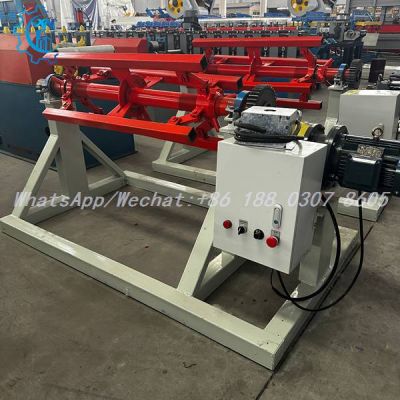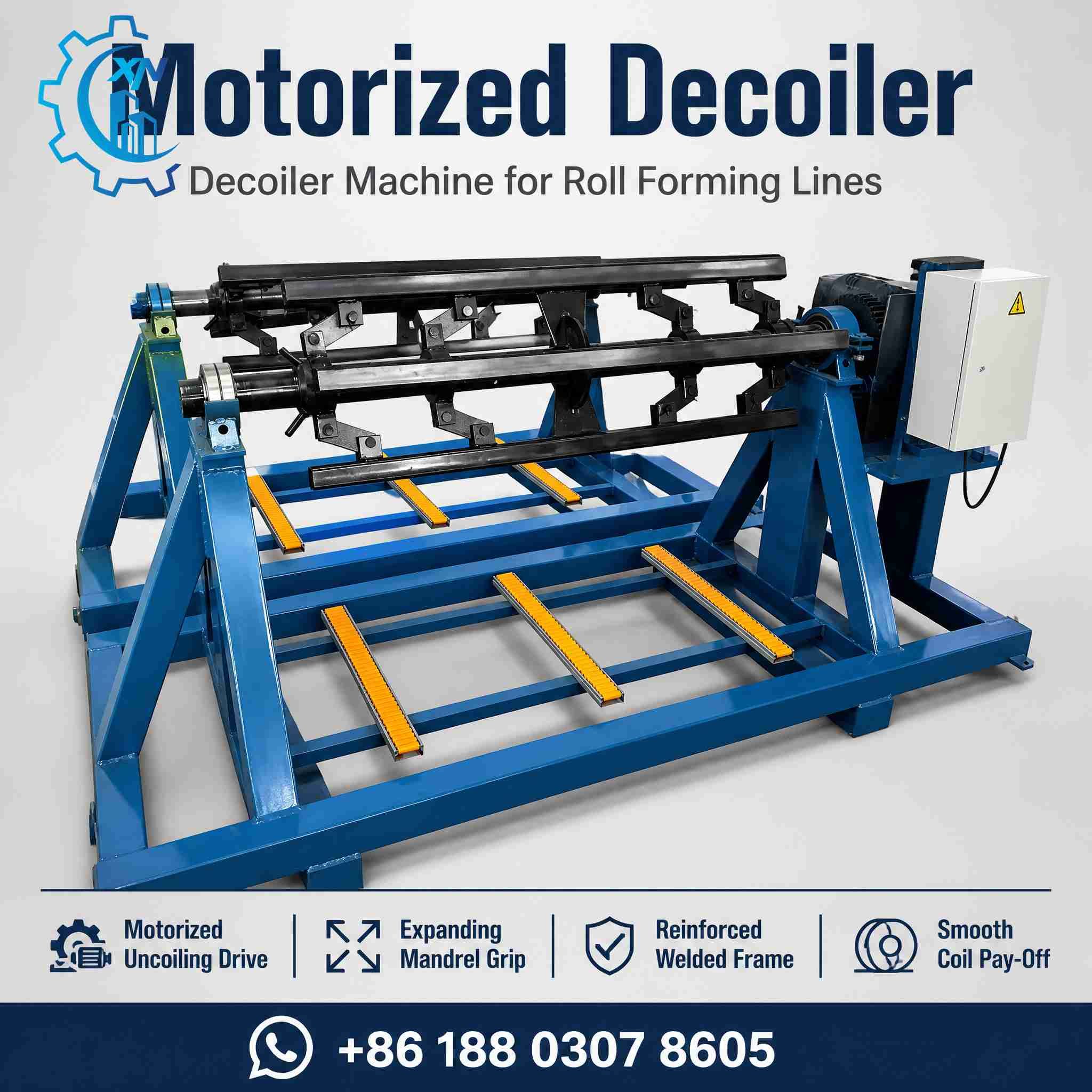
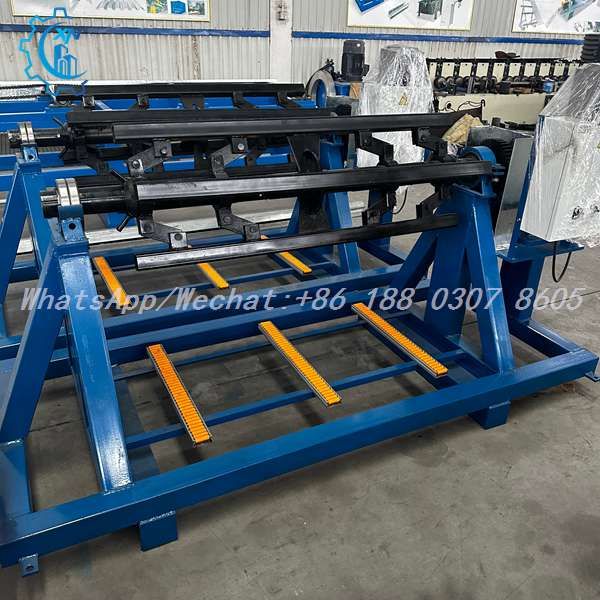
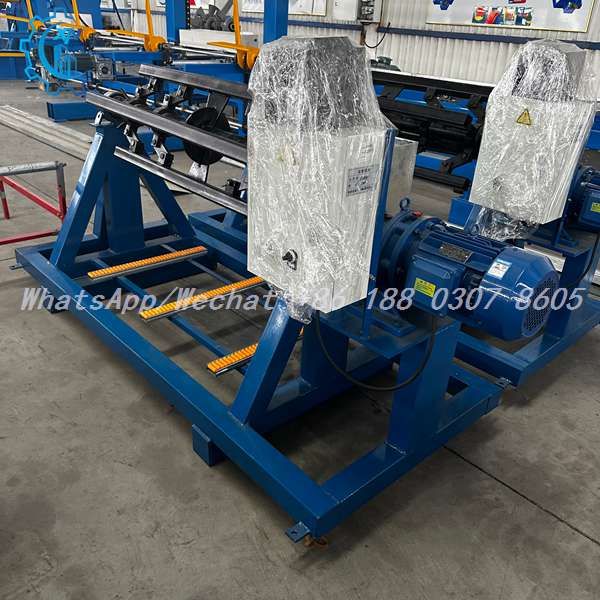
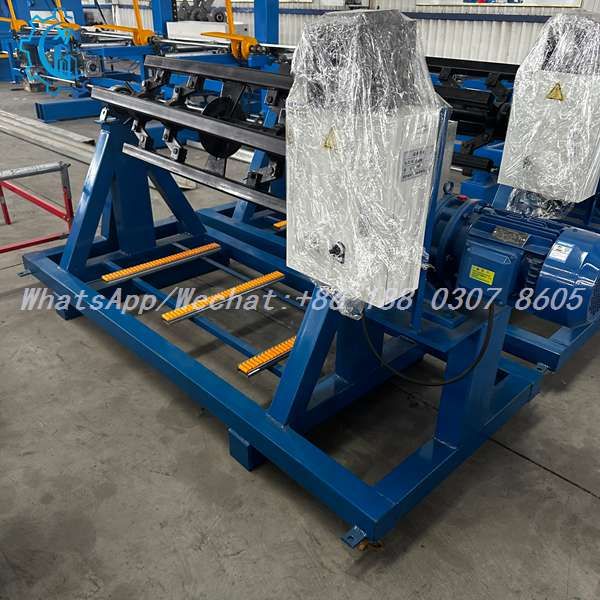
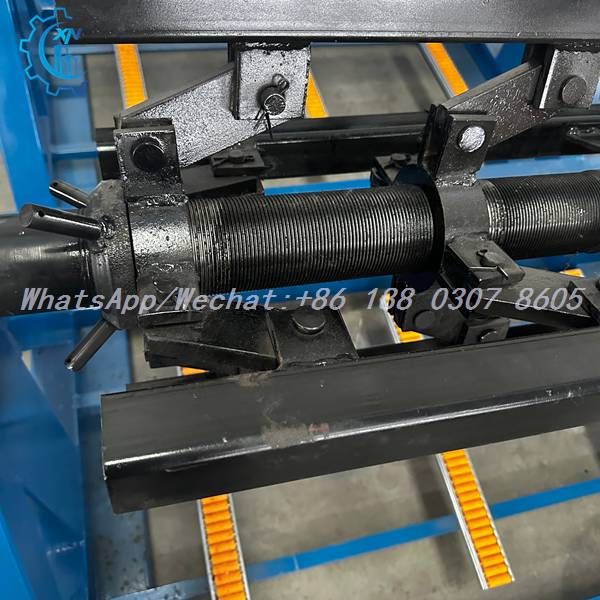
1. Decoiler machine with screw-type expansion mandrel - turn the threaded screw and the wedge shoes spread out to grip the coil bore securely.
2. Hinged hold-down arm with pivot brackets keeps the coil steady and prevents strip whip during unwinding.
3. Blue welded square-tube frame with grooved anti-slip treads; spur gear drive end takes the motor unit.
4. Mob/WhatsApp/Wechat: +86 188 0307 8605
5. Email: sara@xinnuomachine.com
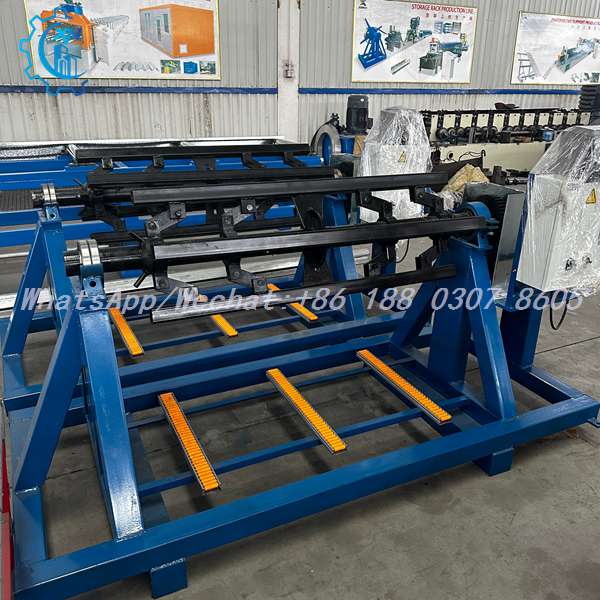
Complete view of the decoiler machine in our workshop: the blue square-tube frame is welded into a splayed A-shaped base with orange grooved anti-slip treads along the bottom sill, and the black upper assembly carries the hold-down arm and its pivot linkage over the mandrel shaft. Roll forming stands stand behind.
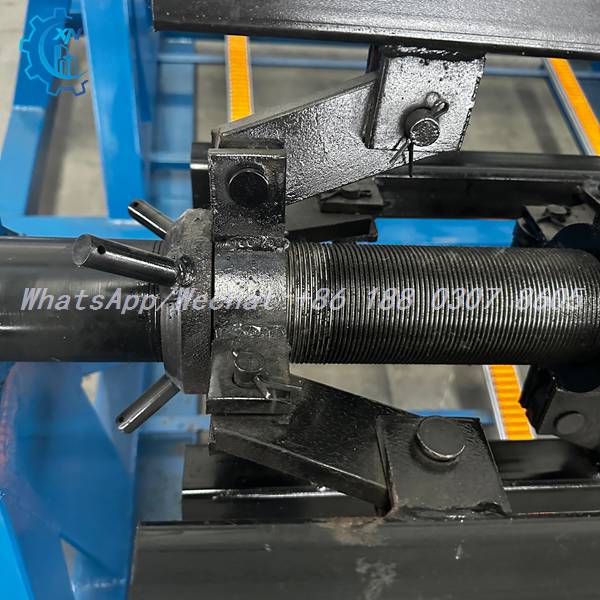
Core module of the decoiler machine: the fine-pitch threaded screw ends at a machined hub with a cotter-pin cross bolt, the tensioning pin of the screw-expansion mandrel, while two heavy hinged pivot brackets with large hex bolts form the expanding-arm linkage and an angled upper arm with a pivot pin.
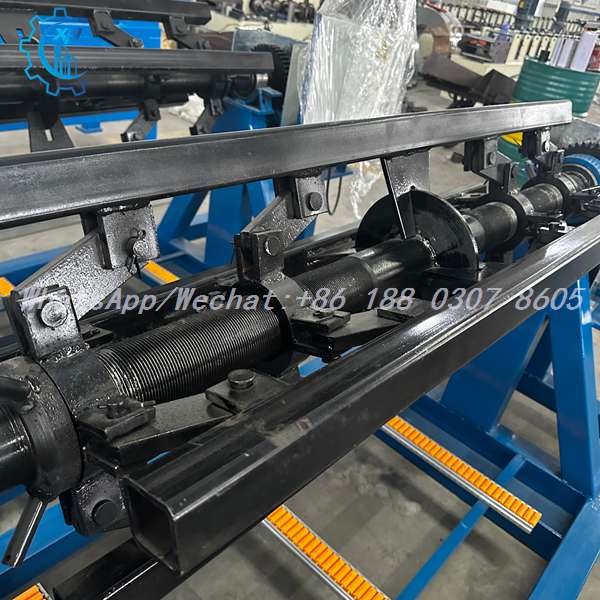
Looking down the mandrel axis of the decoiler machine: wedge-shaped expanding shoes sit between slotted spreader plates around the threaded screw shaft, with a machined collar mid-shaft, while the black square-tube hold-down frame crosses the foreground on a bolted pivot bracket above the orange tread rails.
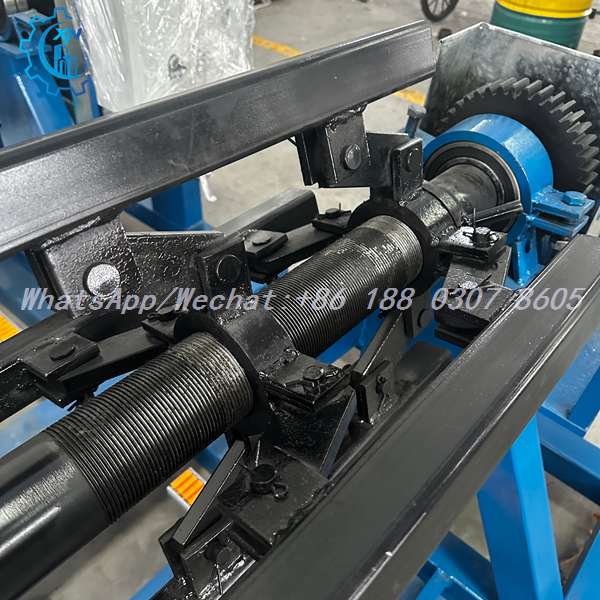
Drive end of the decoiler machine: the large cut spur gear on the mandrel shaft meshes toward the blue-painted bearing carrier bracket with cap-head bolts, the interface where the pinion and motor unit couple on. Behind it, the screw shaft carries the expanding wedge shoe clamped by a pivoting arm with slotted linkage.
Decoiler Machine - Manufactured by XINNUO Since 1995
XINNUO has built cold roll forming equipment since 1995, and the decoiler machine is produced in the same workshop as our forming lines rather than bought in from outside. The frame is welded from square steel tubing, the mandrel is machined and assembled in-house, and the screw expansion mechanism is fitted and tested before the unit leaves the factory - which is why we can size the decoiler machine to the coil your line will actually run instead of selling a fixed catalogue size.
The design uses a screw-type expansion mandrel: turning the threaded screw drives the wedge shoes outward against the coil bore, so one mandrel covers a working range of coil inner diameters. A hinged hold-down arm with pivot brackets rests on the coil to steady it during unwinding, and the drive end carries a spur gear that couples to the motor unit.
Because we also manufacture the downstream machines, the decoiler machine is matched to strip width, coil weight, line speed and the gap between the decoiler and the forming section - typically about three metres in our standard layouts, with decoiler lengths in the 1.0 to 1.7 metre range. Units serve purlin lines, roof and wall panel lines, composite panel lines, shutter door lines and cut-to-length lines, with over 150 countries supplied and long-term spare parts support.
Q1: How does the screw expansion mandrel grip the coil?
A: The mandrel carries a fine-pitch threaded screw with wedge-shaped shoes between spreader plates. Turning the screw pushes the shoes outward against the coil bore, so the coil is held from the inside and rotates with the mandrel shaft - no separate chuck or adapter needed.
Q2: What is the hinged hold-down arm for?
A: It rests on the outside of the coil through a pivoted linkage with pivot brackets. As the coil unwinds and its diameter shrinks, the arm follows it, keeping the coil steady and suppressing strip whip so the strip leaves the decoiler machine cleanly.
Q3: How do I choose between a manual, motorized and hydraulic decoiler machine?
A: Manual units suit light coils and low output. Motorized units, driven through the spur gear end, suit continuous lines where strip must be fed and reversed under power. Hydraulic units suit heavy coils, where the mandrel expands hydraulically and a coil car loads the coil. Tell us your coil weight and we will recommend the right level.
Q4: What coil weight and bore can the decoiler machine handle?
A: The frame and mandrel are sized to your specification - coil weight, bore diameter, outer diameter and strip width are the four inputs we need. That lets one decoiler machine cover a range of bores through the screw expansion travel instead of a single fixed diameter.
Q5: How does the decoiler machine keep tension while the line runs?
A: Strip runs off the decoiler into a free loop ahead of the forming machine, and the drive is matched to line speed with variable-frequency control available. The loop absorbs the difference between decoiler and forming speed, so the strip feeds without tension spikes or slack.
Q6: What installation and foundation does it need?
A: The unit is delivered assembled and tested, and normally stands on a level concrete floor with anchor points; heavy configurations use a foundation block sized to the coil weight. We supply the layout drawing with the decoiler position and the recommended gap to the forming section before shipment.
Q7: What maintenance does the decoiler machine need?
A: Daily checks cover the coil seating and the anti-slip treads, plus a visual check of the strip path. Periodic work is lubrication of the screw thread and pivot points, inspection of the gear drive and bearing carrier, and a check of bolt torque on the frame and brackets. We provide a maintenance sheet with the machine.
Q8: Can the decoiler machine be matched to my existing forming machine?
A: Yes. Send the make, strip width and line speed of the forming machine you already run, plus your coil data, and we will confirm the mandrel size, drive rating, decoiler height and the gap so the new unit slots into your existing line.
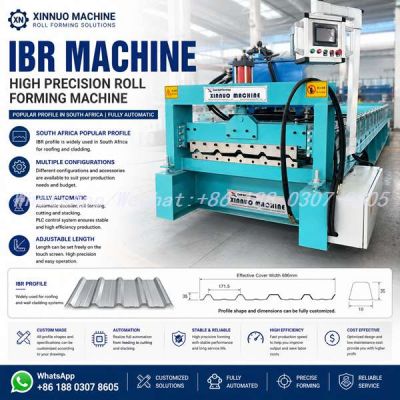
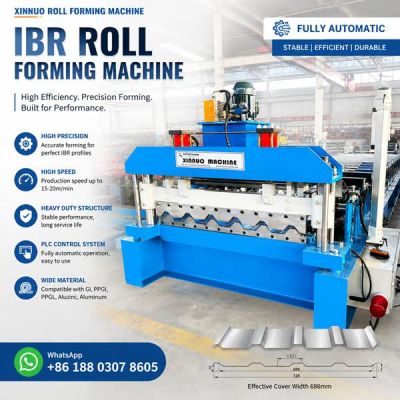
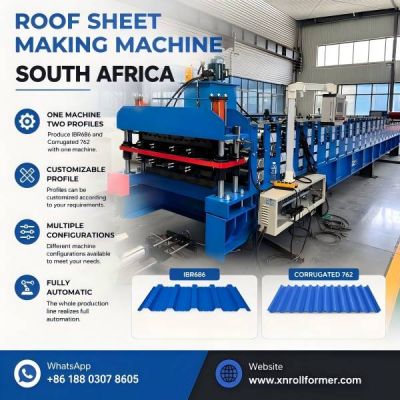
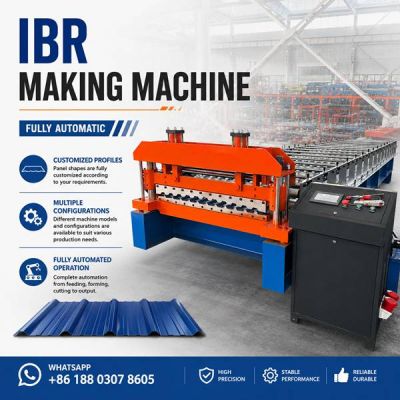
XINNUO ROLL FORMING MACHINE CO., LTD is a professional manufacturer specializing in high-quality ibr making machine and advanced ibr machine solutions. With years of industry experience, we provide reliable, efficient, and customized roll forming equipment to meet global roofing production needs, ensuring stable performance, precision forming, and long-term durability for our customers worldwide.
[ read more ]