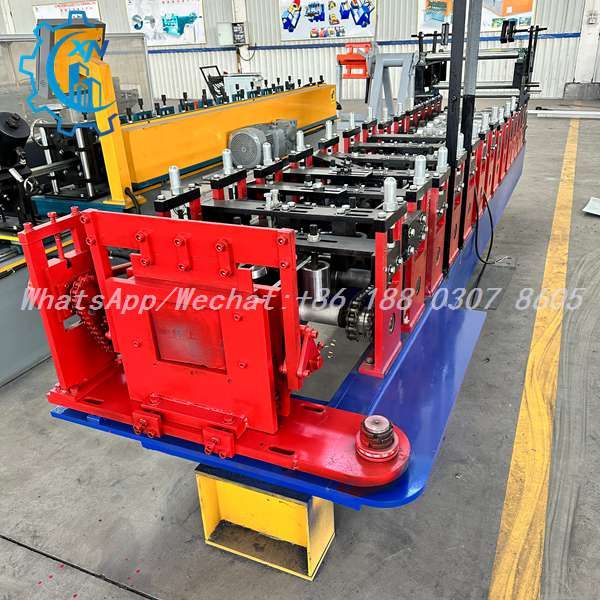
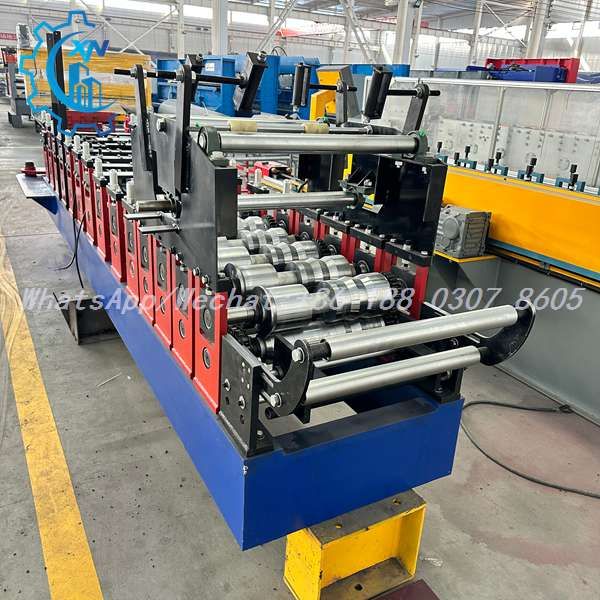
1. Forming precision: the roll gap at every stand is set by a pair of studs and lock nuts on the top plate, and each roll pair is machined to the section on your drawing, so section tolerance holds from the first length to the last.
2. Complete line on one base rail: entry guide, multi-stand forming section, chain-and-sprocket drive along the side of the stands and a lever cut-off at the run-out — coil in, cut-to-length gutter out.
3. Custom build: gutter depth, bottom width, bead and hem radius come from your drawing, and the cut-off blade is machined to that same section.
4. Mob/WhatsApp/Wechat: +86 188 0307 8605
5. Email: sara@xinnuomachine.com
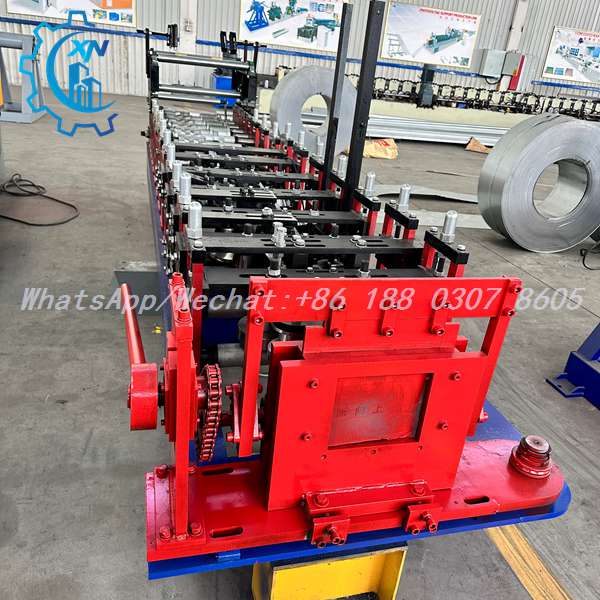
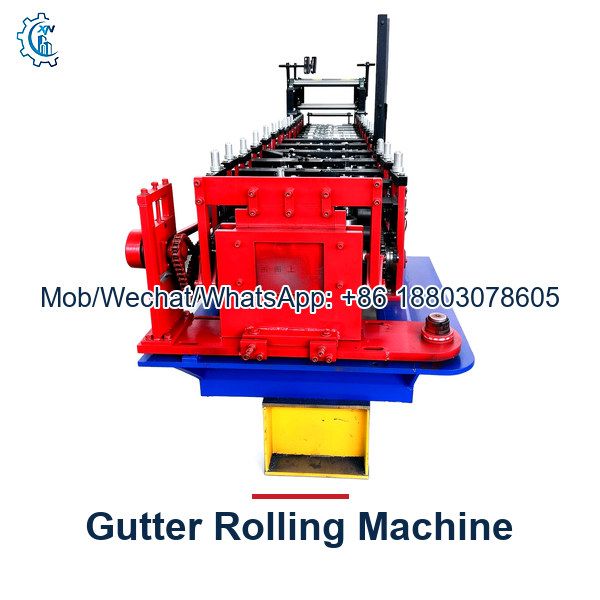
A gutter rolling machine seen from the cut-off end: the red housing carries the blade plate behind a rectangular window, and the long red lever arm on the left is the handle the operator pulls to complete the cut-off stroke. Behind it the multi-stand forming section runs away with a black top plate and adjusting studs at every stand, and two steel coils stand on the floor at the right.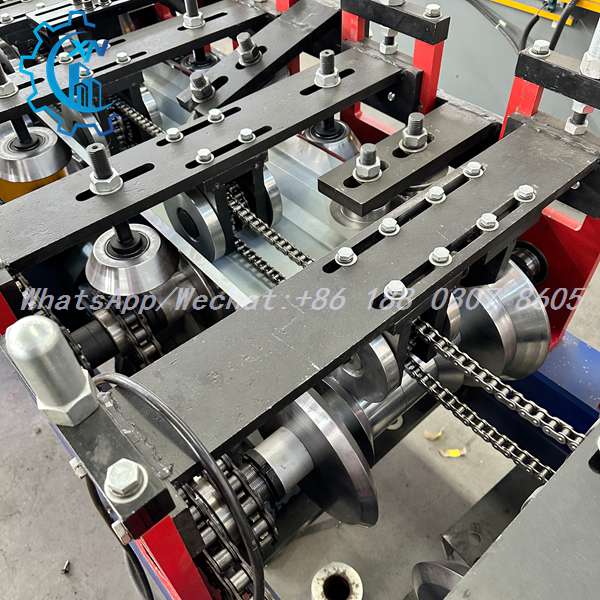
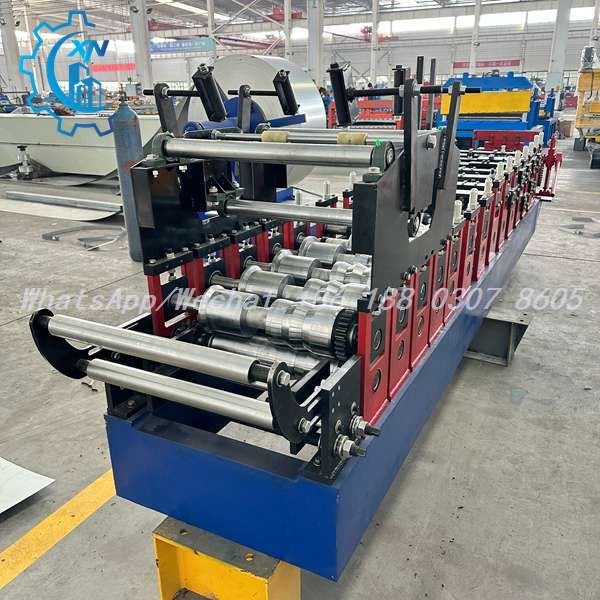
Looking down the forming section of a gutter rolling machine: every stand carries a heavy black top plate with a pair of studs and lock nuts for roll gap adjustment, and the roller chain steps from sprocket to sprocket along the side, linking one stand to the next. The chromium-plated rolls show the gutter profile machined into the body, and the red frames and blue base rail hold every stand on one centre line.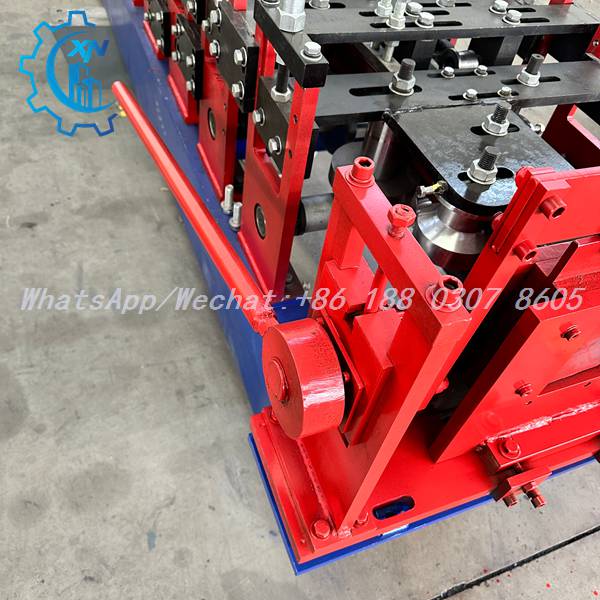
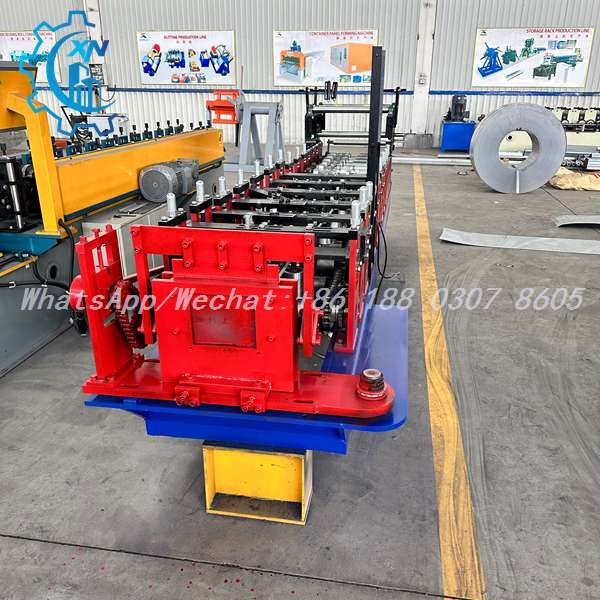
The lever linkage of a gutter rolling machine in close-up: a slim red arm pivots on a cast boss bolted to the stand, the red side plates behind it are cut with rectangular windows that open the shafts for inspection, and a black top plate with four studs sits above the last roll pair. The blue base rail carries the whole assembly and keeps the cut-off square to the pass line.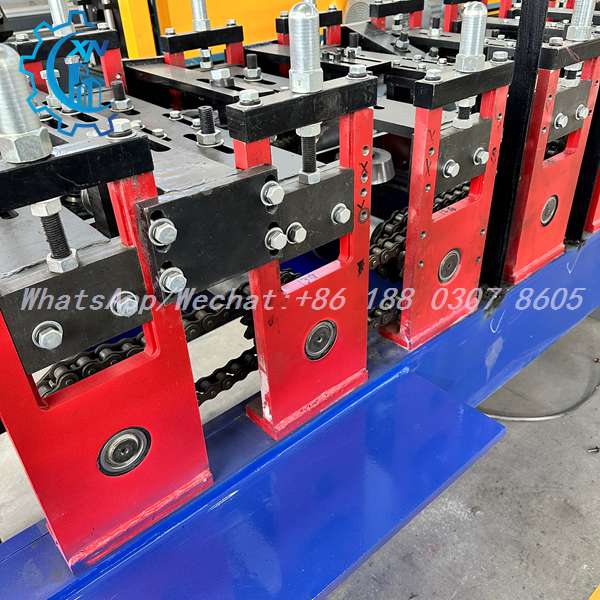
Two adjacent stands of the gutter rolling machine side by side: black top plates with vertical studs and lock nuts, the roller chain passing between the stands at two levels, and red side plates cut with oval openings around round bearing caps. The blue base is a single rail, so the line is levelled once at installation and stays on the same plane. An orange machine housing sits in the background.
FAQ
1. What does a gutter rolling machine actually do?
It turns flat coil into a finished gutter length: the strip is guided into the first stand, formed progressively through the stands that carry the section, and cut at the run-out to the length the job needs. One machine, one profile, repeatable lengths — the point is that the gutter is made where it is measured, so the run does not depend on what a supplier has in stock.

2. Which gutter profiles can be made on it?
The profile is defined by your drawing, and the rolls are machined to it. Depth, bottom width, the shape of the bead and the hem radius are the numbers that matter: give those and the section can be quoted, rolled and checked. Half-round, K-style and the local gutter shapes used in different markets all come down to the same question — what does the drawing say.

3. Does the line punch or slot as well as form?
Forming and cut-off are the base machine. Punching, slotting for outlets and end details are added as tooling in the line or done as a second operation, and which one applies depends on how many pieces you make and where the holes sit. Tell us the hole pattern and the outlet positions when you enquire, and the answer comes back with the tooling in the quotation instead of as a surprise.

4. What coil thickness and material does it run?
Galvanized coil is the everyday material for rain gutter, with galvalume and pre-painted coil used where the finish matters. Thickness is not a free choice: it sets the load on every stand and the force the cut-off blade has to carry, so it is fixed together with the section. Send the coil specification you can buy locally and the quotation comes back with the range that section will run.

5. Can the profile be changed to our own drawing later?
Yes, and the route is decided before the order. A second set of rolls, machined to the new section, runs in the same frames — that is the option for a workshop that intends to widen its range. A second machine is the answer when two profiles have to run at the same time. If a change is already planned, say so when ordering: it changes the clearance allowed in the frames.

6. How is the machine installed, and what training is included?
The machine arrives assembled on its base rail, so installation is levelling, connecting the supply and running the first coil. The manual covers the setting of each stand, the cut-off and the daily checks, and commissioning support is by video call or on site as agreed. Operators are trained on their own coil and their own profile, which is the only way the first length and the hundredth come out the same.

7. What is the lead time and what does the warranty cover?
Lead time is quoted with the machine, because it follows the station count and the tooling on the order, and it starts from the confirmed drawing and the deposit. The warranty covers the machine as built and does not cover wear parts such as blades, nor damage from coil outside the agreed specification. Both are written into the quotation, so there is nothing to argue about later.

8. How do I request a quote?
Send four things: the gutter profile drawing with its dimensions, the coil material and thickness, the lengths you cut, and the supply voltage at your site. With those in hand the quotation comes back with the stands, the coil width, the cut-off, the line length and the delivery — usually within one working day. A sketch with the main dimensions is enough to start if the drawing is not finished yet.

Still deciding on the section? Send the gutter drawing and the coil thickness; the reply carries the full specification, the layout drawing and the price within one working day. Owners of an existing machine can write for a replacement roll set or a blade on its own: that work is quoted separately. If the drawing is open, a sketch with main dimensions is enough to start.XINNUO ROLL FORMING MACHINE CO., LTD is a professional manufacturer specializing in high-quality ibr making machine and advanced ibr machine solutions. With years of industry experience, we provide reliable, efficient, and customized roll forming equipment to meet global roofing production needs, ensuring stable performance, precision forming, and long-term durability for our customers worldwide.
[ read more ]