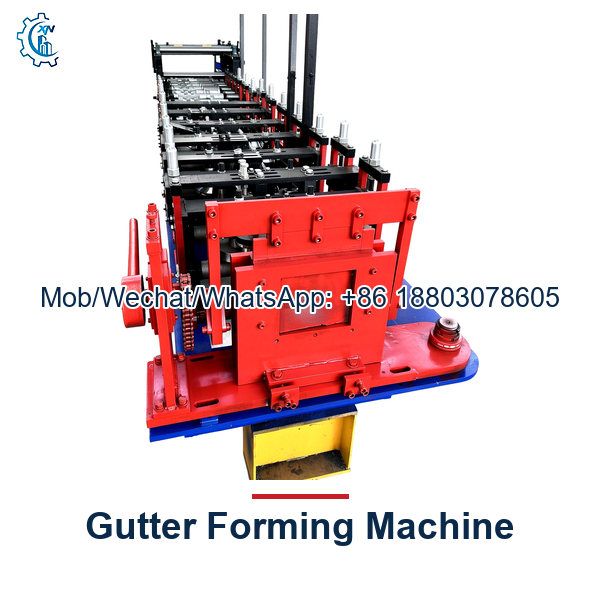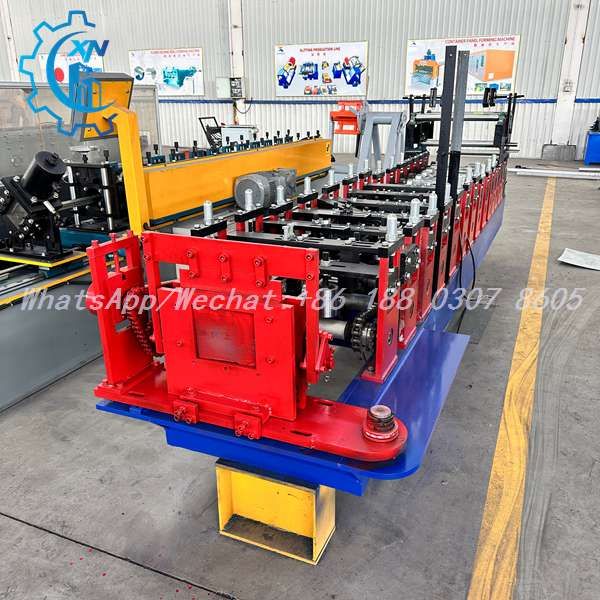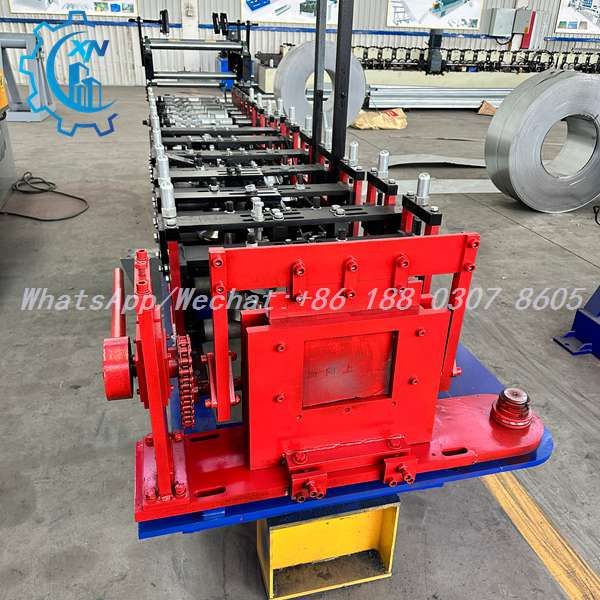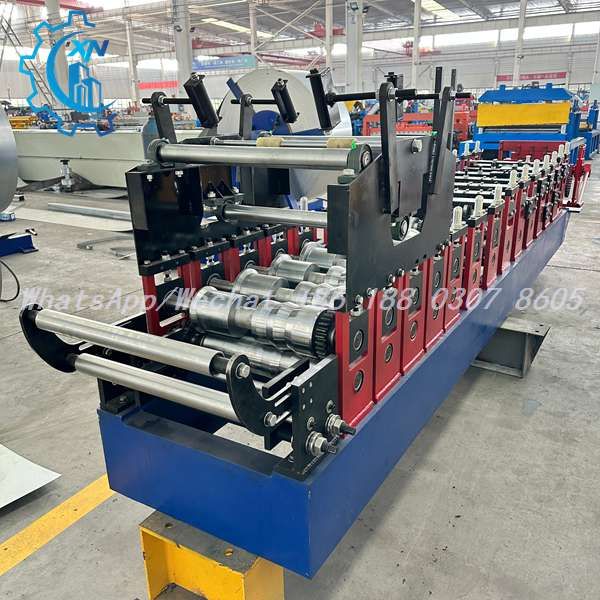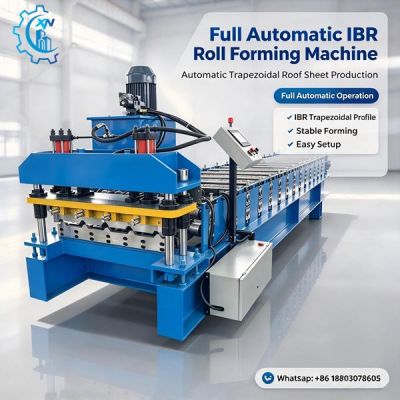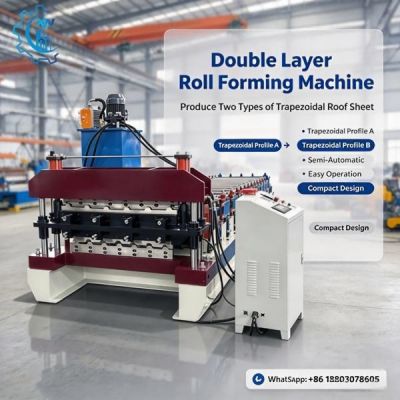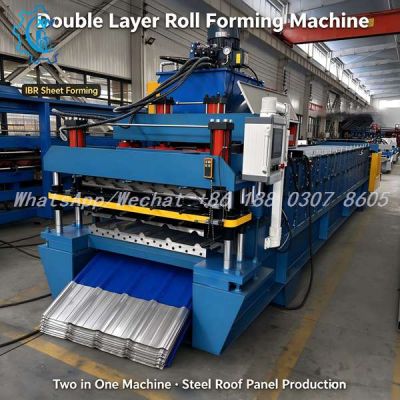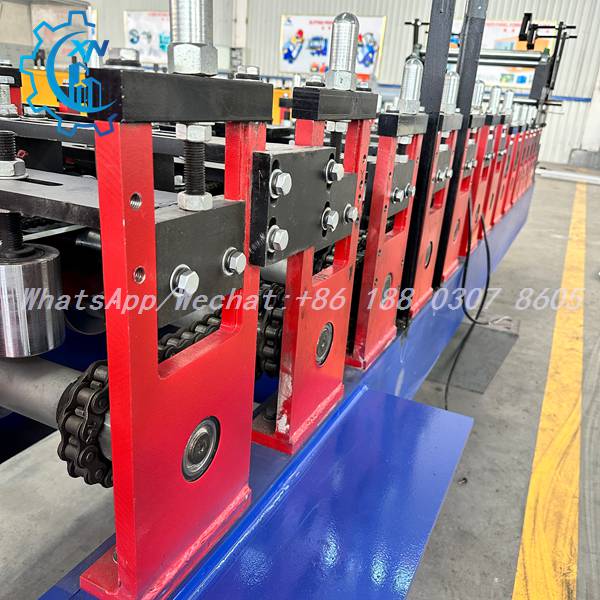
A row of stands along a gutter forming machine: red frames with round bearing covers, black top plates with adjusting studs, and the chain appearing between each pair of stands. The blue base runs under the whole row, and the yellow floor line marks the walkway beside it. Other roll forming machines stand back in the same bay, in build or waiting for coil. Each bearing cover sits low on the plate, level with the shaft it carries.
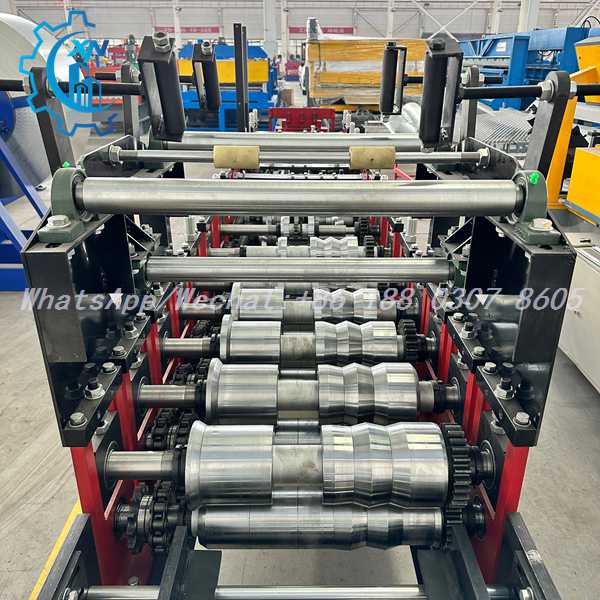
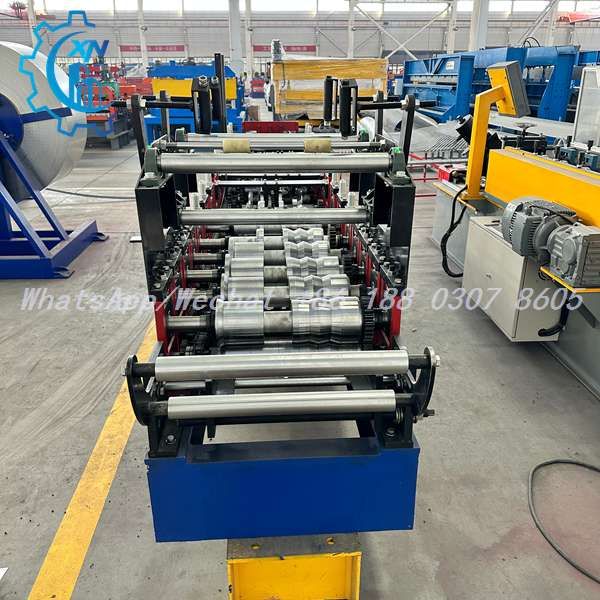
Looking into the forming section of a gutter forming machine: three tiers of chrome rolls sit one above the other, with long chrome guide bars carrying the strip across the top of the stands. Black side plates with lever arms close the near end, and the red frames and blue base run back into the shop, where other machines stand in the bay behind. The gap between the tiers is where the strip runs.
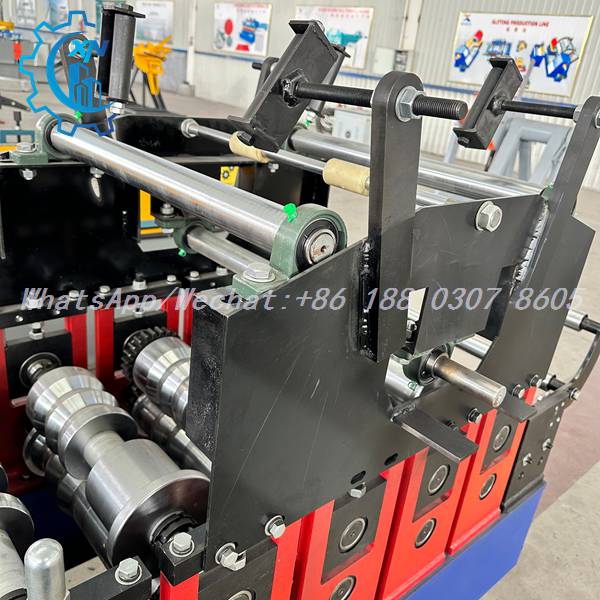
Inside the stand group of a gutter forming machine: the black side plate carries the shaft ends, a pair of chrome rolls sits between the plates, and the long chrome tie bars run the length of the machine to hold every stand on one line. A lever arm stands at the right of the plate, and the red frames and blue base sit underneath. Factory posters hang on the wall behind.
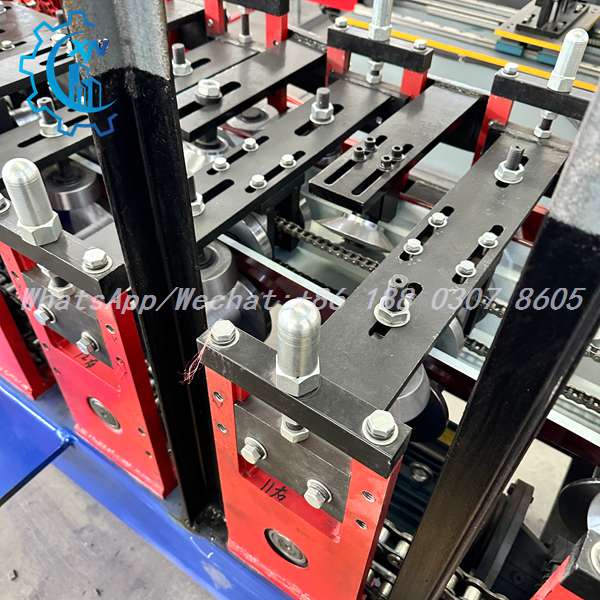
Over the top of the stands on a gutter forming machine: each black top plate carries two studs with lock nuts, the pair that sets the roll gap for that stand alone, and every plate is bolted down to a red frame standing on the blue base. The roller chain shows below the plates, running from one stand to the next. Heights are set stand by stand, not across the line.
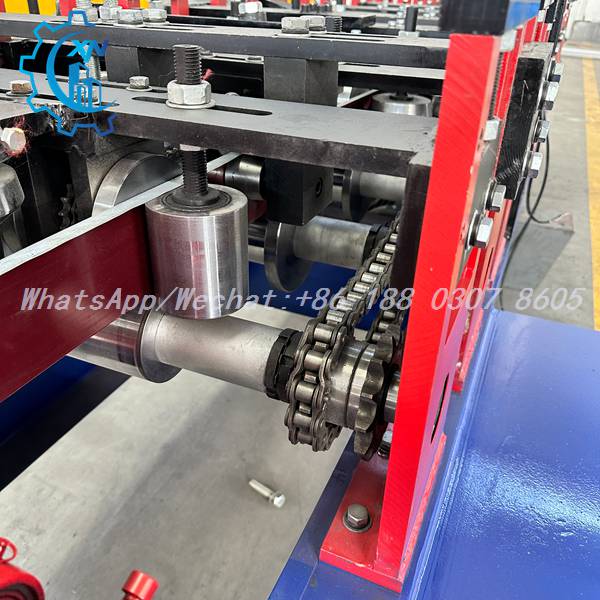
The chain drive at the side of a gutter forming machine: the sprocket is keyed to the shaft below the last roll pair, and the chain wraps it before running on to the next stand. The bearing cap is bolted to the red frame beside it, the chrome roll above shows the section machined into its body, and the blue base plate closes the frame at floor level. Behind it, the next stand repeats the same arrangement.
Factory introduction
XINNUO opened in 1995 and has stayed inside one trade: cold roll forming. Thirty years on, the design office, the machine shop and the assembly bay are still under one roof, and the people who draw the roll set are the people who stand at the machine when the first coil runs.
The works builds gutter forming machines for rain gutter work, and beside them IBR and trapezoidal roof machines, purlin lines, sandwich panel lines, ridge caps and arching equipment. Gutter work and roof work share one shop floor, so a section that is new to one product line is seldom new to the works.
Every stage stays in-house: plates are cut and welded here, rolls are turned and matched to the section here, and the machine is assembled and wired here before it is run. That run is made on the coil the buyer intends to use, with the finished section checked against the drawing and the result written down.
Buyers in more than 150 countries run these machines. Support is answered in English, documentation is translated into the buyer's language, every part carries a code rather than a description, and commissioning help comes by video or in person, whichever the contract allows.
| Parameter |
Data |
| Section formed |
Rain gutter / guttering to the buyer's drawing, with bead and hem as drawn |
| Coil material |
Galvanized, galvalume or pre-painted steel |
| Coil gauge |
To be confirmed against the section and the material |
| Coil width |
Set by the developed width of the profile |
| Number of stands |
To be confirmed — follows the section, the radii and the material |
| Roll gap setting |
Two studs with lock nuts on the top plate of each stand |
| Drive |
Chain linking stand to stand; motor and reduction unit to be confirmed |
| Rolls |
Turned and chrome finished, section cut into the body |
| Frame |
Welded steel side plates and red stands on one base, levelled at installation |
| Cut-off |
In the same frame at the run-out, blade cut to the section |
| Electrical |
Built to the site supply; state voltage, phase and frequency when ordering |
FAQ
1. How does the machine turn coil into a gutter section?
In passes. The strip is guided into the first stand, bent a little further at every stand after it, and straightened out of its springback by the time it reaches the last pass. Nothing is done in one hit: the section is built up stage by stage, which is why the number of stands and their spacing follow from the profile rather than from a standard frame length.
2. What section shapes can the rolls be cut for?
Any section that can be drawn and formed: half-round, K-style, box gutter and the local shapes used in different markets. What the rolls need is a dimensioned drawing — depth, bottom width, the bead and the hem radius. With that, the roll set is turned and the profile checked on the machine before shipment.
3. Is punching, notching or slotting part of the forming line?
It can be, and the decision is a production one. Where the outlet and end details repeat, the tooling goes into the line and the part comes off finished. Where they vary from job to job, a separate bench operation is cheaper and more flexible. Send the hole pattern and the outlet positions with the enquiry and the choice is made on your numbers, not on ours.
4. Which coil gauges will the stands accept?
The stands take what the section was designed around — gauge is not a free setting. A heavier coil loads every stand harder and asks more of the cut-off blade, so the range is fixed with the drawing. Tell us the coil you can actually buy locally, and the answer comes back with the gauge band that section will run, not with a generic figure.
5. Can we add a second profile without a second machine?
Yes, on one condition: the frames were specced for it when the order was placed. The extra money sits in the roll set, not in the machine. Where both sections have to run at once, a second machine is the saner answer. Say at the order if another section is planned for year two — the clearance inside the frames is fixed then, not later.
6. What does commissioning involve, and who trains the operators?
The machine ships assembled, so there is nothing to rebuild on site: level it, bring the supply in, run a coil. Training happens on that first coil, on the buyer's own section rather than a demo profile. The manual, translated, walks through each stand setting, the cut-off and the checks that belong in a shift.
7. How long from order to shipment, and what is covered after that?
Dates go out with the price, because both move with the stand count and the tooling. The clock starts at the confirmed drawing and the deposit, not at the enquiry. Cover runs on the machine as built; blades and damage from coil outside the agreed specification are not in it. Dates and cover both appear in the offer.
8. What is the quickest way to get a price?
Four answers unlock the price: the section with its dimensions, the coil and its gauge, the cut lengths, and the supply at your site. Stands, coil width, cut-off and delivery all follow from those. A working day is the usual turnaround. If the drawing is still on the back of an envelope, that is fine — we start from a dimensioned sketch.
Questions on a section you are planning? Send the drawing and the coil gauge; the answer comes back with the stand layout, the roll set and the price, normally inside one working day. If you already run our machine and need a roll set or a blade, write to the same address — that is quoted on its own.
Mob/WhatsApp/Wechat: +86 188 0307 8605
Email: sara@xinnuomachine.com