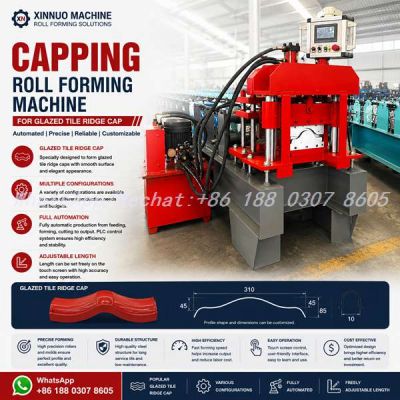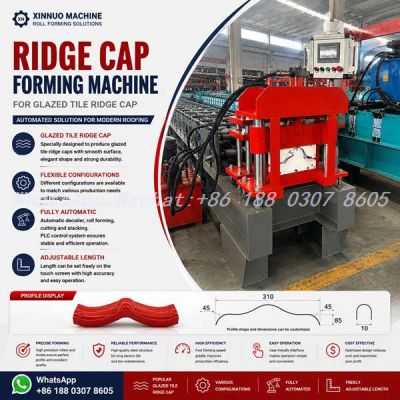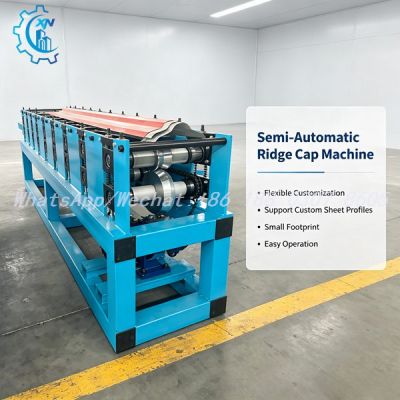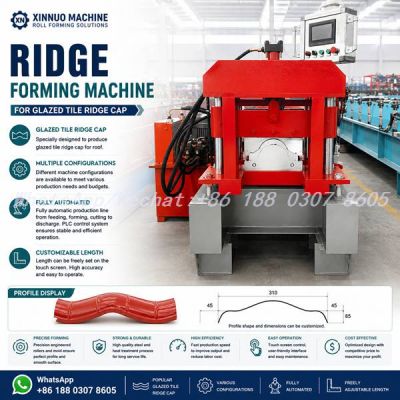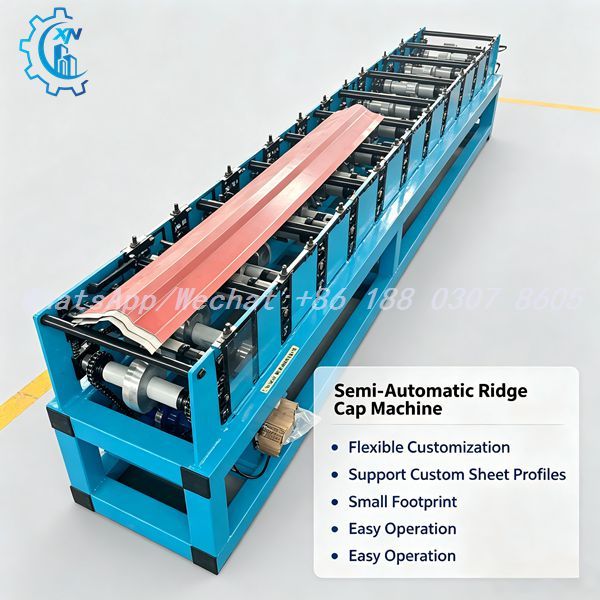
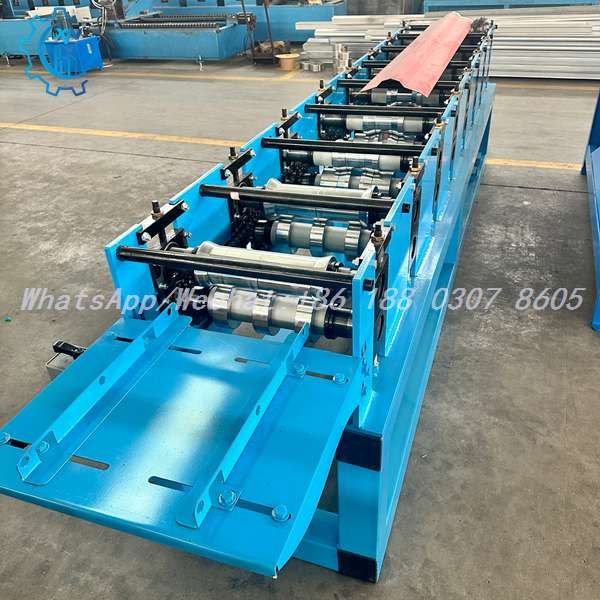
1. Ridge cap machine built on a light welded frame with 7 to 21 forming stands - the machine goes into a small workshop bay and needs no heavy foundation.
2. Semi-automatic working: feed the narrow coil, form the ridge profile, cut the length at the machine. One operator and a 2.2kW to 5.5kW supply are enough.
3. Profile matched to the roof sheet you already sell - 250mm to 714mm feed width, 175mm to 600mm covering width, so the cap laps one corrugation each side of the ridge.
4. Mob/WhatsApp/Wechat: +86 188 0307 8605
5. Email: sara@xinnuomachine.com
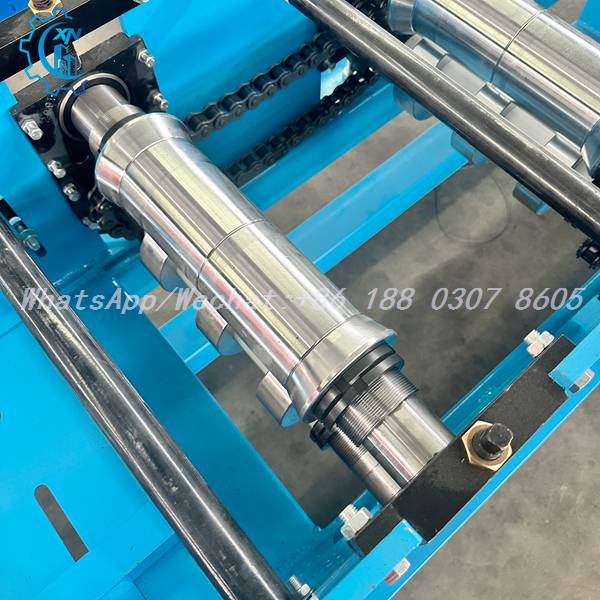
The shaft end of the ridge cap machine is machined to a fine thread and locked with a row of jam nuts against a chrome journal, with a large hex bolt and washer pinning the black bracket to the blue side plate. A machined slot in that plate and two parallel black guide rods run below the roller, and packing film is still stuck to the drum section. An upper roller and its chain drive are partly visible above.
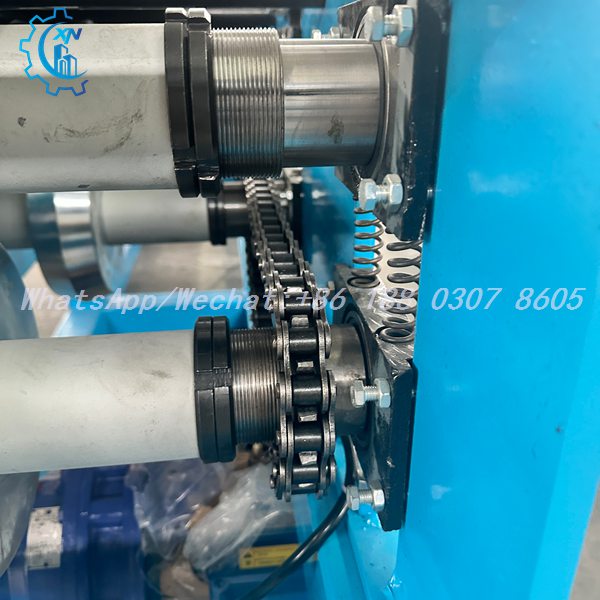
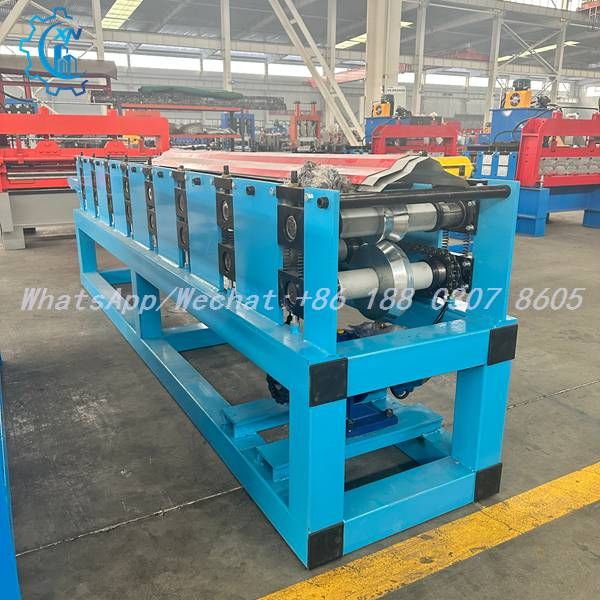
Two roller chains share this side of the ridge cap machine: one runs diagonally into the lower black sprocket, the other across to the upper sprocket, and pale coil springs tension the runs beside hex bolts on the blue plate. Each shaft end is locked with two to three jam nuts, the shafts pass through black brackets, and the blue base below carries bolts, a yellow label and a cable.
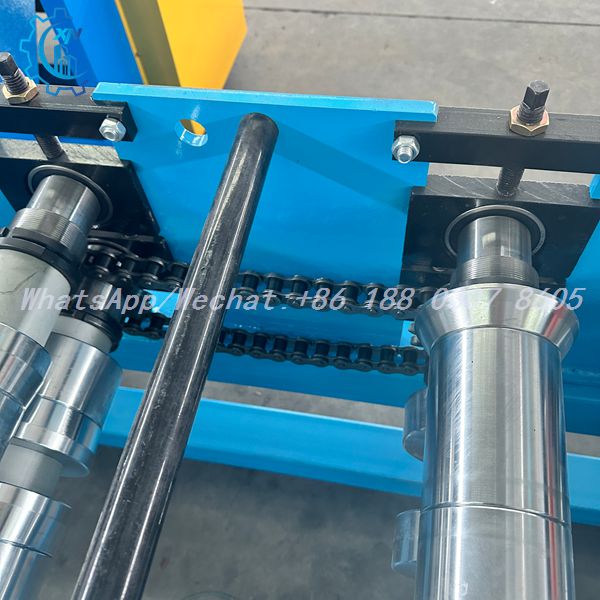
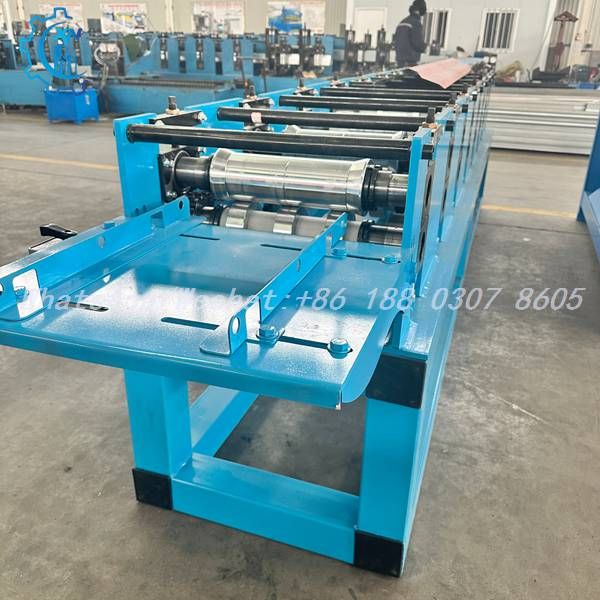
Polished stepped rollers are stacked on two vertical shafts inside the ridge cap machine, each roller built from drum segments with shoulder grooves and ring collars, while a roller chain crosses the mid-frame over its sprocket with a second loop beneath it. Black cross plates above carry threaded adjusting studs with brass nuts, black square bars bolt across the plain blue side plate, and the shafts turn on chrome journals in black blocks.
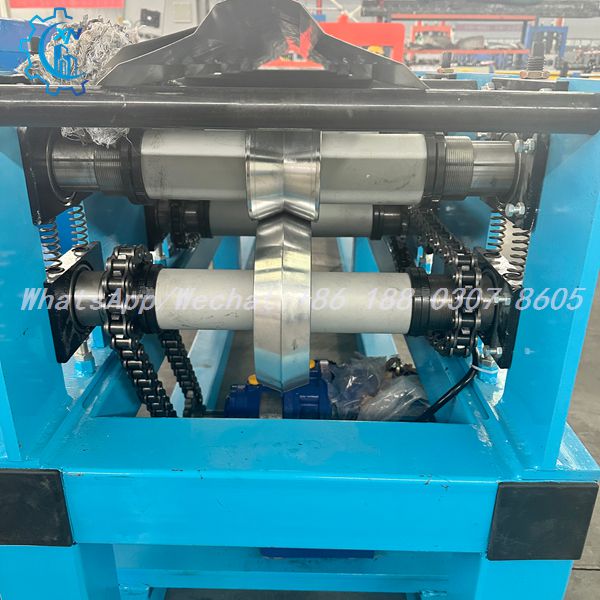
Between the two shafts of this station on the ridge cap machine the ridge shape is set: each shaft carries a raised angular band machined with flat facets, and the strip takes the fold between them. The shafts turn in black machined bearing brackets, with chain on the left and right of the shafts and a large black sprocket at the lower left, coil springs beside the bracket and blue guide parts below.
Ridge Cap Machine - Made in the XINNUO Workshop Since 1995
Most buyers of a ridge cap machine already sell roof sheets. The cap is the companion product on the same roof, and buying it from someone else means paying a margin on a short profile you could roll yourself. That is the situation this machine is designed for.
XINNUO has built cold roll forming equipment since 1995, and the ridge cap machine is the compact end of that range. The ridge profile is short and symmetrical, so it needs only 7 to 21 stands instead of the 15 to 26 a panel machine carries. Fewer stands mean a shorter machine on a lighter frame, and that is where every other advantage starts: it drops into a small workshop bay, it runs from a supply as modest as 2.2kW, it takes narrow coil from 250mm to 714mm so offcuts from panel production can be used, and it can be moved to another site without building a new foundation.
This is the semi-automatic build. The operator feeds the coil, the stands form the profile, and the length is cut off at the machine - no automatic decoiler, no stacking section, no long run-out frame to buy, install or power. Chrome rollers with threaded adjustment and lock nuts let each stand be set accurately and held there, and the chain drive runs with spring tension on both sides of the shaft so the two roll ends stay synchronised.
Covering width runs from 175mm to 600mm, matched to the roof sheet you already produce - 760, 840, 900 and 1000 profiles are all common pairings - and switchable feed widths are available where you run several panel models. Machines ship to more than 150 countries with profile drawings, layout drawings, operator training and long-term spare parts support.
Q1: Should I make ridge caps in house or keep buying them from a supplier?
A: If you already sell roof sheets, the ridge cap is the same roof, the same coil supplier and the same customer - but it arrives with somebody else's margin on it. A semi-automatic ridge cap machine is small and cheap enough that the decision usually comes down to how many caps you move per month, not to whether you can afford the machine.
Q2: Who normally buys a semi-automatic ridge cap machine?
A: Three groups. Roof sheet producers adding the companion product so they can quote a complete roof package. Roofing contractors who fit as well as supply, and want caps in the length and finish they actually use. And traders who buy sheets and caps for resale and would rather roll the caps themselves than carry a supplier's price.
Q3: What sets the production pace on a semi-automatic machine?
A: Not the forming speed - the profile is short and the stands run at normal line speed. The pace comes from the manual cut-off and the coil change, so output depends mainly on how the operator works and how often the coil runs out. That is the trade-off you accept for the low cost, small footprint and simple maintenance of a semi-automatic build.
Q4: Can one machine run caps for several roof sheet models?
A: Yes, in two ways. A machine can be built with switchable feed widths - one reference build covers 333mm, 400mm and 500mm feed positions - or a second roll set can be supplied for a different profile. Tell us which roof sheet models you sell and we will confirm which route is cheaper for your mix.
Q5: What does the machine need from the workshop?
A: A level concrete floor and an anchor point, a supply of 2.2kW to 5.5kW depending on the build, and one operator. Because the machine is compact and the frame light, a heavy foundation block is not normally required - one of the reasons it suits rented or temporary premises.
Q6: What maintenance does a ridge cap machine need?
A: Chain tension and chain lubrication, a check of the jam nuts and lock nuts that hold each stand setting, cleaning and light oiling of the roll surfaces so coated strip is not marked, and a periodic check of bearing temperature. The parts that wear are common items - chain, sprockets, bearings and the adjustment hardware.
Q7: Which steel is used for ridge caps?
A: The same material as the roof sheet it matches, so the colour and finish line up: pre-painted steel in the panel colour, or galvanised and Aluzinc-type coated strip where the roof is left bare. Ridge caps run in the thickness range of the roof sheet, and we set the roll gap for the material you specify.
Q8: What do you need from me to quote, and how long is delivery?
A: Send your roof sheet model or profile drawing, the sheet thickness, the ridge width you need and the material. We reply within 24 hours with a matched profile drawing and a price; delivery is typically 20 to 35 days depending on configuration, with the machine test run on your profile before packing and spare parts supplied long term.
XINNUO ROLL FORMING MACHINE CO., LTD is a professional manufacturer specializing in high-quality ibr making machine and advanced ibr machine solutions. With years of industry experience, we provide reliable, efficient, and customized roll forming equipment to meet global roofing production needs, ensuring stable performance, precision forming, and long-term durability for our customers worldwide.
[ read more ]